You’d think “keyword difficulty” is a pretty easy topic to define, and you’d be right.
Keyword difficulty (or KD) is a subjective metric measuring how much effort it takes to rank for a given keyword. Different tools like Moz, Ahrefs and Semrush give keyword difficulty scores, but their scores can differ substantially due to differences in how they weight the factors they use in their calculations. Keyword difficulty is a limited metric that we don’t recommend incorporating into your content planning except to choose between two keywords that are otherwise exactly alike.
If you want to know more about keyword difficulty, from how to find high-volume / low-competition keywords to how it’s calculated and whether we recommend you using it at all, read the post below.
Is keyword difficulty important?
I personally don’t put much stock in keyword difficulty. It’s not something I incorporate into my content plans, and I do tend to tell clients what I really think about it!
I’ve got a few reasons. First, keyword difficulty is “in the eye of the beholder”, so to speak. It’s a general term that in practice refers to the subjective opinions of different tools, and different tools can disagree because they calculate their keyword difficulty scores in different ways. It’s not a concrete, objective score along the lines of word count or something along those lines.
I also think the use case for it is quite limited. Let’s say you’re an estate agent in Manchester, and you want your homepage to rank for “estate agent in Manchester”. Makes sense! Well, regardless of what any particular tool tells you is the keyword difficulty for that keyword, you want to rank for it, right? And regardless of what any tool says about keyword difficulty, on my end, I would want to build blog content around that keyword to create authority around that topic. And the same applies for building backlinks — I’ll be doing that anyway, using that keyword as the anchor text regardless. The only thing keyword difficulty tells you here is how good your content might have to be and how many backlinks you might have to build. Nothing about your goals or my content plan / link building campaign changes either way. So what’s the use case?
I also think (I have a lot of opinions about keyword difficulty) it’s a bit pointless if you’ve got a brain, frankly. You don’t need a tool to tell you that “car insurance comparison” is going to be a high-competition keyword: there’s a lot of money riding on who ranks first. You also don’t need a tool to spit out some pre-digested KD score if you’re comparing a keyword with 10 search volume per month to one that has 10,000. Which do you think is going to be the more difficult to rank for?
All that being said, I don’t think KD is worthless. I just think there are better metrics you can spend your time thinking about when you’re making a content plan.
How is keyword difficulty calculated?
How keyword difficulty is calculated depends on the tool you’re using. Factors typically accounted for include:
- The number of backlinks that sites already ranking for that keyword have
- The number of backlinks the specific pages already ranking for that keyword have
- The number of backlinks the tool has been able to find (i.e., particular tools that are less good at crawling and scraping the web may miss lots of backlinks)
- The weighting that the tool decides to give to each of the factors it considers (entirely at the discretion of whoever made the tool)
Like I said above, different tools calculate KD in different ways. Here’s an example actually given by Ahrefs in a post about keyword difficulty:
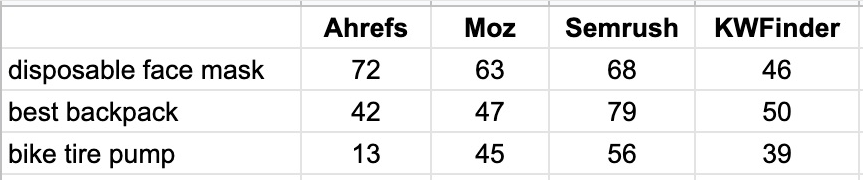
So, Ahrefs give “bike tire pump” a keyword difficulty score of 13/100. Semrush give it a score of 56/100. You wouldn’t put any stock in such a loose metric anywhere else, so I have no idea why people give KD the time of day in SEO, but they do.
What is keyword difficulty for, then?
I wouldn’t recommend incorporating keyword difficulty into your keyword research or content planning, outside of specifically having to choose between two keywords that are otherwise exactly alike. So, if two keywords have the same volume, are each as relevant to your business as the other, and are each as easy to incorporate into your content as the other, pick the one with the lower keyword difficulty.
Keyword difficulty is also a useful metric if you need to justify an SEO decision, e.g. if you’re working in-house on a digital marketing campaign, and you need to explain something in a report to the higher-ups. They love obscurely-generated numbers.
Another use case for keyword difficulty — and this is one where I would actually recommend it — is if you’re creating a niche informational site. In the 2010s it became popular to create niche blogs and monetise them with ads or affiliate links, to the point where people started selling “systems” that were “guaranteed” to give you the “financial freedom” to “generate passive income”. Building sites like these was one of the ways I got into SEO. Now, people were building sites left right and centre on topics that they didn’t even have expertise in; they would just pick a topic and run with it. For them, keyword difficulty was a great metric, because it told them how much competition there was for the niches they were considering. Building random informational sites is nowhere near as common as it used to be (Google algorithm updates + competition from AI-generated sites + competition from AI overviews saw to that). But if for some reason you want to build a random niche informational site in 2026, then yeah, use keyword difficulty to help pick your niche.
What level of keyword difficulty should you target?
It depends on your budget. The more budget you have, the less relevant keyword difficulty is, because more and more difficult keywords are open to you. The less budget you have, the more thoughtful you have to be about your backlink budget. So, if you have no budget at all, start with low-volume, low-difficulty keywords; if you have a big budget, do what you want.
Even so, I wouldn’t recommend avoiding certain keywords in your content just on the basis of their keyword difficulty. Google prefers natural content, so if I avoided using the keyword “keyword difficulty tool” in this post just because of its KD score, what am I achieving there? Not covering a topic that would naturally fit in my content? Working around a made-up metric and actively ignoring advice directly from Google about the kind of content they want to rank? That’s backward thinking.
How to check keyword difficulty with Semrush
Semrush is probably the best beginner-friendly SEO / keyword difficulty tool. Start with their Keyword Overview tool: type your keyword in and set the location to UK.
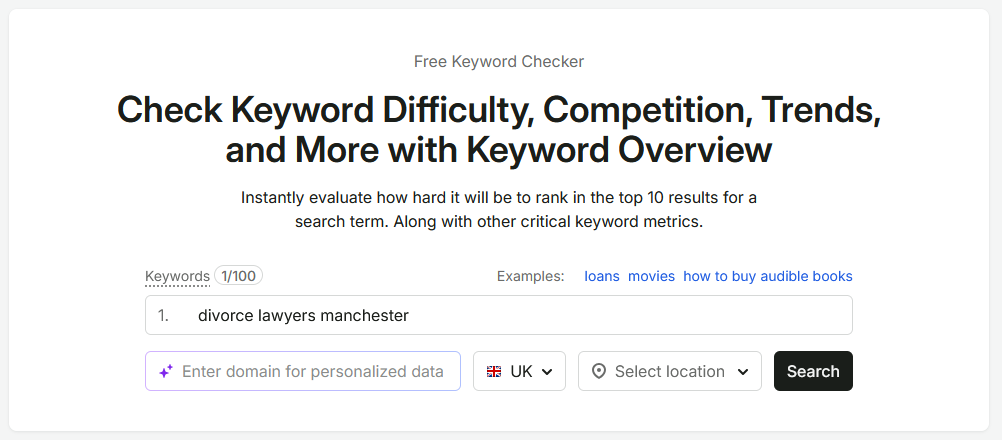
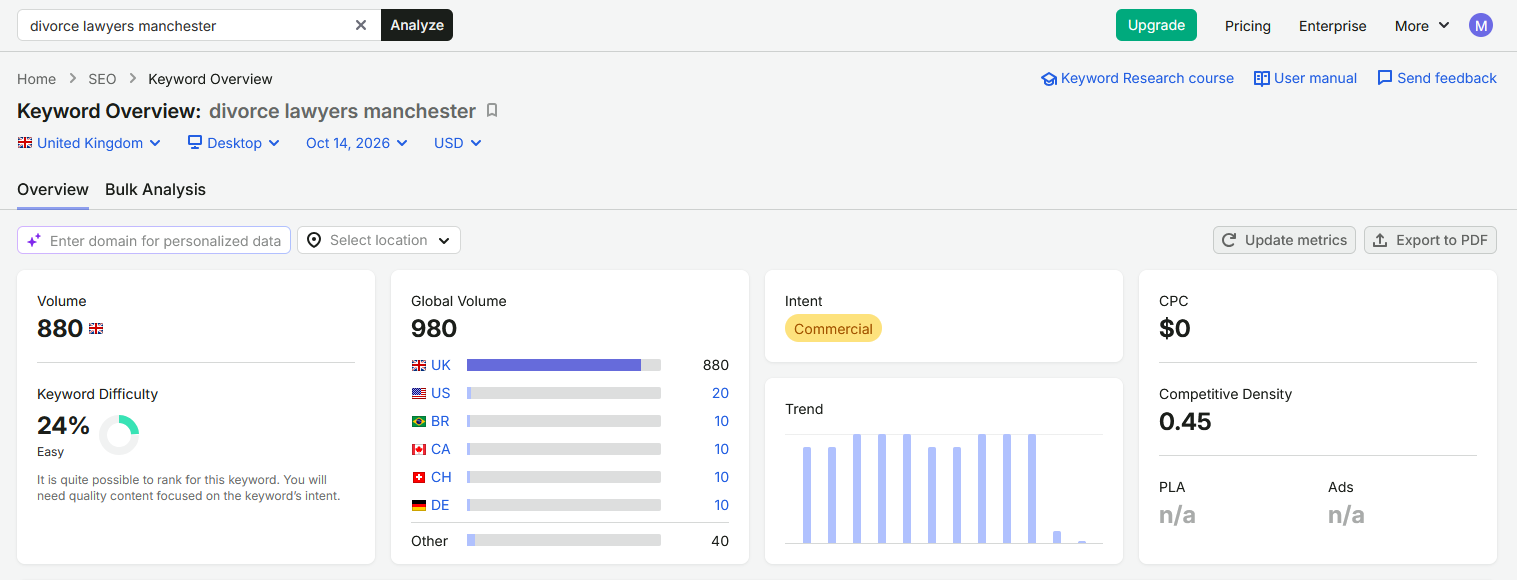
You end up here, which among other things, tells you that the keyword difficulty score for “divorce lawyers manchester” is 24%, which Semrush considers easy. Not a bad choice for a core keyword, then, with its decent monthly search volume.
Alternatively, you could use their Keyword Magic tool. I would actually recommend doing it this way because you get context for the keyword difficulty score you’re given. So, again, head there, type in your keyword, and set the location if it isn’t set already.
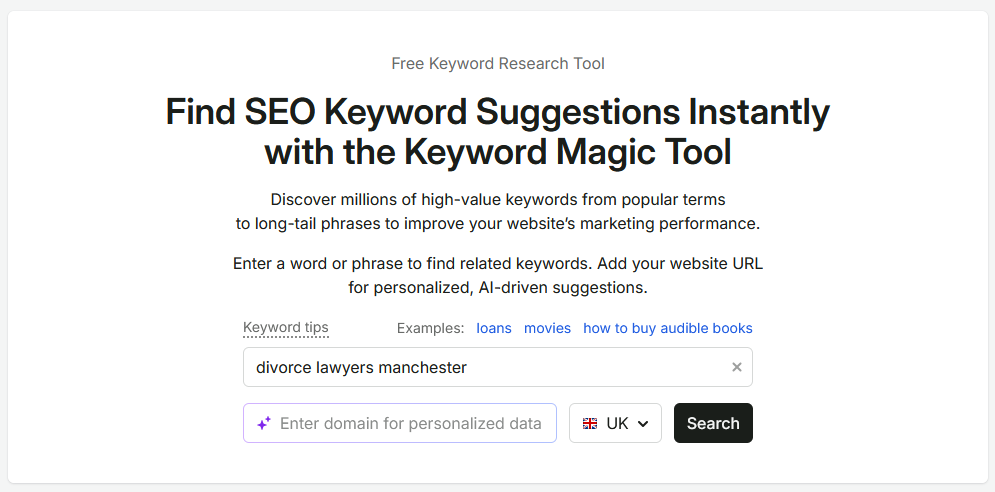
You’ll get a result that looks like this:
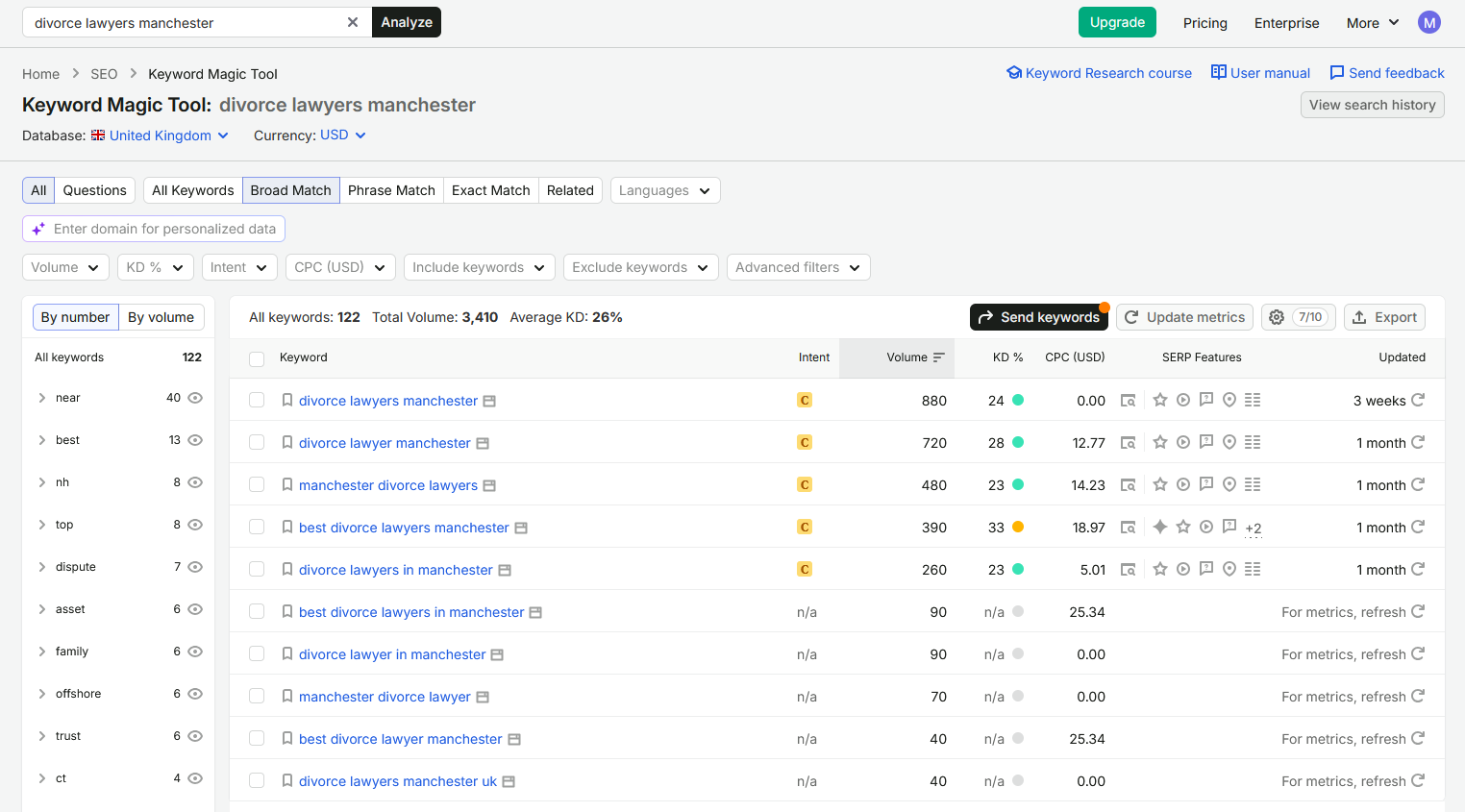
So, you get lots more information here. “Divorce lawyers Manchester”, again, is 24%. But here we also learn that among the keywords Semrush considers to be related, it actually has the best volume, which is interesting. And at 24% KD, it should be easier to rank for than something like “best divorce lawyers Manchester” at 33%. (In reality, you won’t notice that difference, but the point is the same — you’re getting more information here).
How to check keyword difficulty with Ahrefs
Ahrefs actually have a free keyword difficulty checker that’s very easy to use. Same as Semrush, type your keyword out, set the location you want to check for, and click the big button. If you can’t do that you’ve got no hope.
You get shown a screen that looks like this:
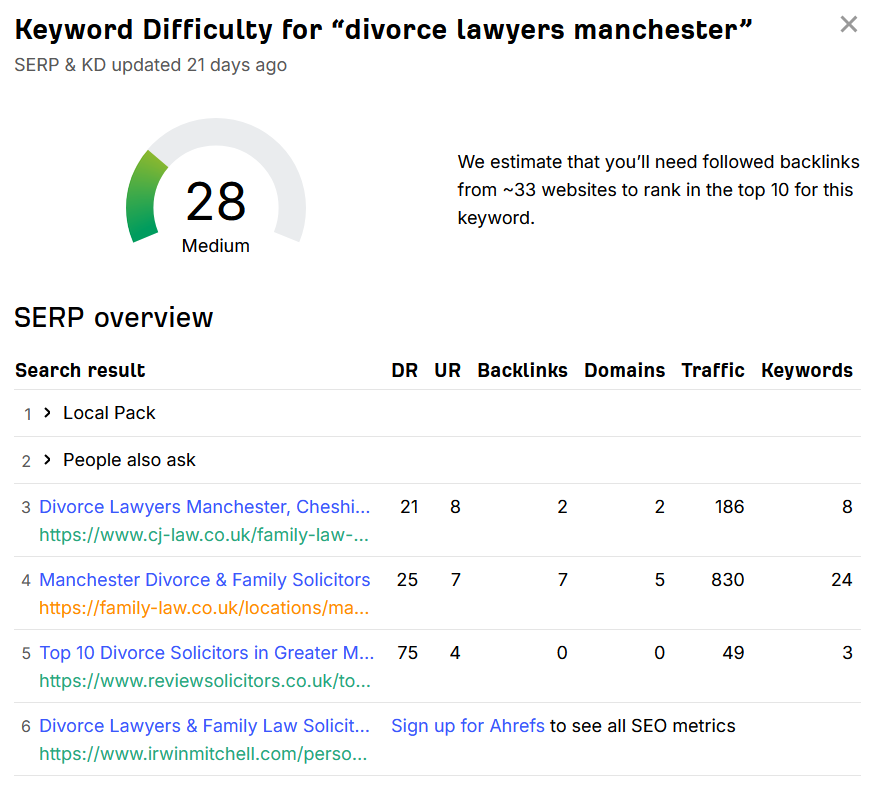
To be fair to keyword difficulty as a metric, Semrush gave a score of 24% and Ahrefs gives 28%, so not far off, although Ahrefs thinks 28 is “Medium” difficulty. But like I said, for all that fluff, if you’re a divorce lawyer and you offer services in Manchester, you’re not going to avoid a keyword even if it is medium difficulty are you?