
Not sure what seasonal keywords are? Or have you heard of them and you’re wondering seasonal SEO might help your site?
Seasonal keywords are keywords that have seasonal peaks and lulls. The peak could be related to a cultural event or holiday like Christmas, a sales event, or something as simple as the weather. The best way to identify whether a keyword is seasonal or not is with Google Trends, but you can also use Google Search Console, Semrush, or many other third party SEO tools. We target seasonal keywords in our SEO copywriting service by using them as page titles and headings, using them in your content, and using them as anchor texts for internal links and backlinks.
This post got a little long (yes, I write the intros last) so strap in, because there’s a lot to cover.
What are the different types of seasonal keywords?
You can categorise keyword seasonality in several different ways, but the categories that make most sense are holiday-related keywords, weather-related keywords, and event-related keywords. Pretty much all seasonal keywords fall into one or more of these categories.
Holiday-related keywords
Holiday-related keywords are keywords that people search for around specific seasonal holidays — so “holidays” as in national holidays, not as in flying somewhere on vacation. Examples of seasonal keywords related to holidays include:
- Christmas keywords. When you think of seasonal keywords, Christmas keywords are probably the first thing you think of. There’s big search volumes, there are huge fluctuations between in-season and out-of-season search volumes, there’s a range of both informational and commercial/transactional searches, and examples spring to mind pretty quickly: “Who played the snowman in Elf” (the sadly departed Leon Redbone, who also provided his unique take on Baby It’s Cold Outside for the end credits alongside surprisingly talented double-threat star-and-singer Zooey Deschanel), “buy Christmas decorations online”, “best Christmas gifts for kids”, and so on and so forth.
- New Year/NYE keywords. Examples aren’t as clean and clear as they are for Christmas, but there are some, like “NYE glasses 2027”. Other than that, the general spike in party-related keywords for things like champagne or party poppers definitely carries on through New Year.
- Valentine’s Day keywords. Valentine’s Day comes hot on the heels of NYE, and is a great example of seasonal informational keywords. “Why do we celebrate Valentine’s Day”, “What to get for my boyfriend/girlfriend/husband/wife/etc. on Valentine’s Day”, “Valentine’s Day romantic date ideas”, “Most romantic restaurants in London”…
- Others: honourable mentions go to other holidays that don’t quite have the volume or cultural significance, but still cause a spike in volume for certain searches, like Easter. “Why is there an Easter bunny”, for example!
Let’s take a look at a particular example with Google Trends, specifically “what to buy for Christmas“. It doesn’t get much more seasonal than this:
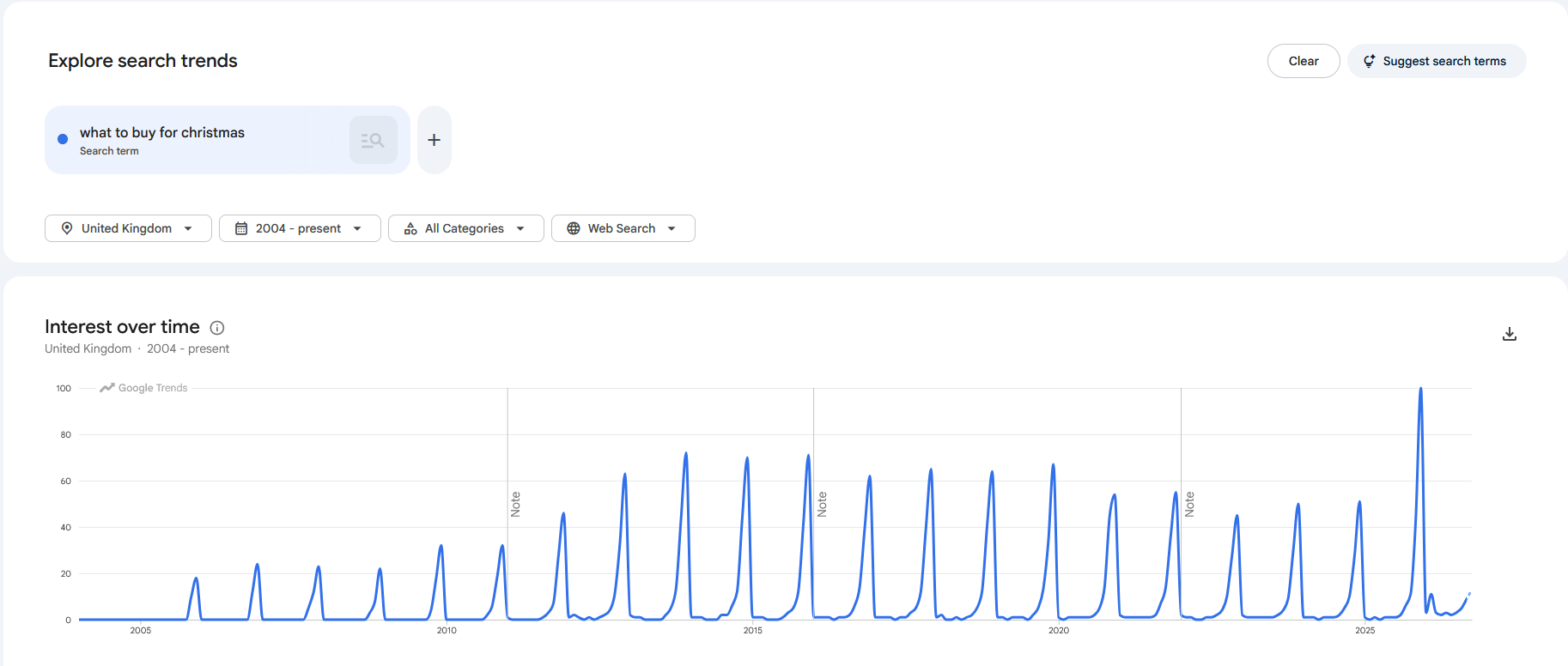
Looking outside the UK, every country has its own holiday keywords. In the U.S. you have all sorts of other national holidays like Labor Day, Columbus Day and Veterans Day. You also have religious holidays that aren’t originally culturally British but are celebrated like Eid, Diwali, Kwanzaa and Yom Kippur. Basically, if there’s an agreed-upon day that’s important to a big group of people for some reason, you’re going to have seasonal keywords related to it.
Event-related keywords
Event-related keywords are like holiday-related keywords. The difference is that they relate to things that have more interest at certain times, but aren’t because of a national or cultural celebration. That might sound a little vague but you’ll know what we mean when you go through the examples:
- Back-to-school keywords. Back-to-school isn’t a national holiday, but it is something that comes but once a year. Any school-related or school supplies keywords peak during back-to-school; school uniform keywords probably have a particularly high correlation, while other related keywords around notebooks and what have you enjoying more consistent traffic through the year.
- Black Friday keywords. Black Friday keywords are the royalty of seasonal keywords. There’s huge search volume, and not just for informational searches, but commercial/transactional searches on big ticket electronics. Generic keywords along the lines of “50 inch TV” get a spike, but there are what you might call “branded” Black Friday keywords too, like “Black Friday TV deals”.
- World Cup, Euros, Wimbledon, Olympics and other sporting event keywords. Not the same as public holidays, but enormously popular and time-limited events all the same. “Best TV for watching the World Cup”, “strawberries and cream recipe”, “pubs with table booking for the semi final”…
Weather-related keywords
Weather-related keywords are seasonal in a different way. Their search volume fluctuates in response to seasonal changes: when it gets warmer, when it gets colder. Examples that come to mind include:
- Clothing keywords. Think of a keyword like “thick winter coat” — the search volume for that will fluctuate to its highest in autumn as the cold weather sets in, and drop back lower once spring arrives. The same applies in reverse to keywords related to summer clothing like shorts, sunglasses, vests, beachwear and so on.
- Cold weather keywords. Think about boiler servicing, radiators not working, defrosting car windscreens, winter car tyres, damp and condensation, flooding. Nobody needs to search for dehumidifiers in the summer.
- Heatwave keywords. When you get unexpected warmth in the spring or late autumn you get a corresponding spike for beer and barbecue keywords, as you might imagine! Then with global warming, there will be all sorts of keywords related to exceptional heatwaves — an example might be air conditioning-related searches, which would previously have been almost unheard of but will only become more common from now on.
Why target seasonal keywords?
If you aren’t yet, and you’re thinking about targeting seasonal keywords, there are probably two things that come to mind. First, there’s the opportunity: maybe you’re leaving money on the table. There’s also the cost in time and effort, magnified by the fact that you’ll only get anything out of seasonal keywords for a brief time each year.
Here are three things we think you should factor into your thinking.
Ranking for more keywords is always better
Our job is to help businesses rank for keywords. As part of that job, we work with the business to identify core keywords; keywords that are the most important to them, that they most want to rank for, that will bring them the most business. Alongside these, we work on secondary keywords: these are keywords which, broadly, are nice-to-rank-for rather than must-rank-for. Generally speaking, one core keyword and a handful of secondary keywords per page are enough for a normal content plan.
That being said, if the budget and scope are there, or those core keywords are already ranking well, ranking for more keywords is always better.
Seasonal SEO often converts well
Seasonal keywords are frequently commercial or transactional in nature. “Commercial” and “transactional” mean two very specific things here; they are two of the four most commonly agreed-upon keyword categories, the other two being “informational” and “navigational”. Commercial searches are comparative searches, where the user wants to find the best estate agent in Manchester, for example; transactional searches are where the user wants to buy something now, like “buy Christmas tree near me”. The active imagination abounds with examples of commercial and transactional seasonal keywords!
Your competitors are targeting them
Last but not least, if your competitors are targeting seasonal keywords but you aren’t, you’re giving them a free run by refusing to compete. Even if you don’t put a lot into it — just whack a page live with the bare minimum of effort — at least it’s live and you’re making them have to beat you, if not earning a little bit more business.
How to track keyword seasonality
So, now you know what a seasonal keyword is, how do you find them? And how do you use them?
How to find seasonal keywords with Google Trends
Google Trends is your best bet if you want to quickly check seasonal keywords / trends. There’s a screenshot from Google Trends above, but let’s get into the detail here.
Google Trends is, of course, Google’s own tool. That means any answer you get from it is “straight from the horse’s mouth”, so to speak. That puts it a cut above other tools that often use estimates to give you an answer. It’s also easier for beginners to understand because it doesn’t give you an answer in absolute numbers, but relative volume. To explain what we mean, take a look at this screenshot of the results for the term “Labubu”:
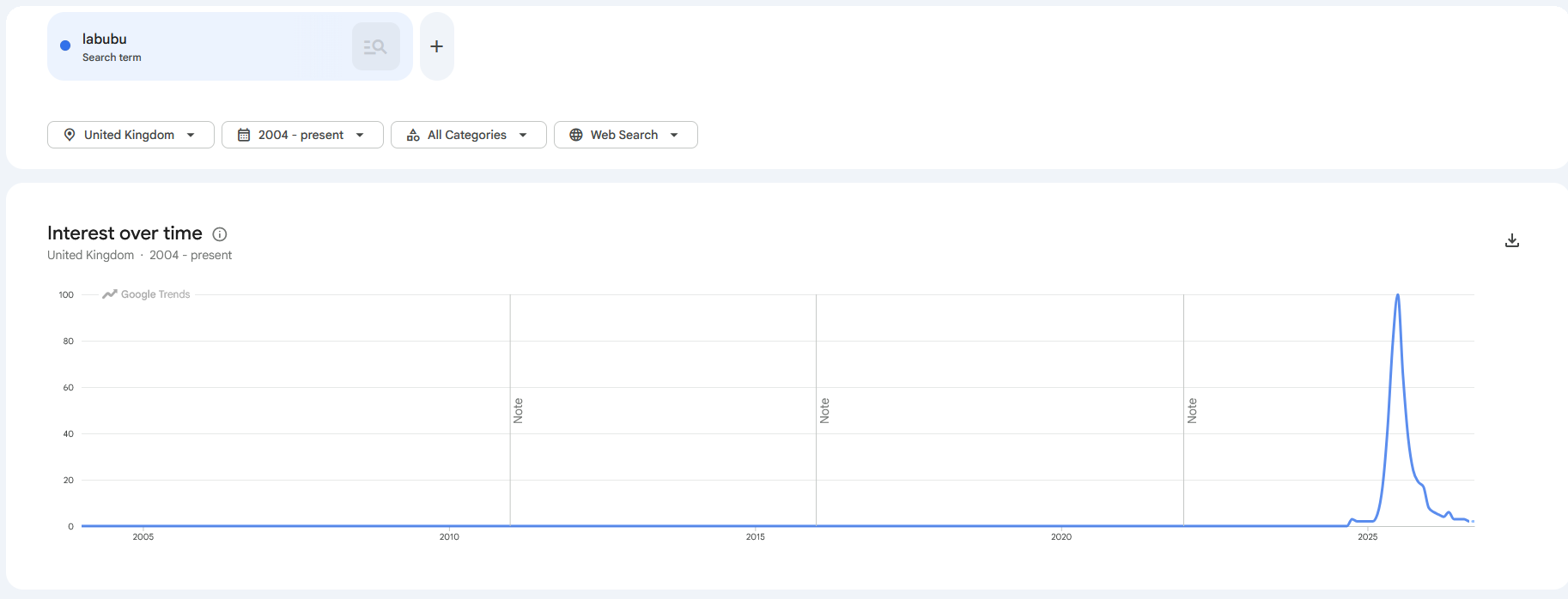
Peak Labubu was July 2025, with a quick tail-off. That’s about right. But take a look at the left hand side of the graph: the spike isn’t being measured in absolute numbers, but on a rating scale out of 100. If you click on the tooltip next to “Interest over time”, it tells you this:
Search interest over a specific time period, displayed on a relative scale from 0 to 100, where 100 signifies the peak interest for the time period of the chart. A value of 50 indicates half the popularity of the peak, and 0 suggests insufficient data.
This means that Google Trends specifically and only shows you how quickly a search hits its peak search volume, and the percentage of that peak that it hits before and after. This standardises every graph it creates so that you can accurately gauge seasonality. It’s basically a purpose-built seasonality- or trend-identifying tool. So, if you want to identify whether a particular keyword is seasonal, use Google Trends.
How to find seasonal keywords with Google Search Console (GSC)
If you want to find out what proportion of the keywords you’re already ranking for are seasonal, you could use Google Search Console.
For the uninitiated, GSC is another of Google’s own tools. You hook it up to your site and it tells you what keywords you’re ranking for, how much traffic you get for each and in total, how many of your pages people can find through Google, and more besides. It’s the best organic-focused analytics tool in my opinion. So, if you want to to analyse your own keywords with real data, start with GSC.
To use it to identify seasonal keywords, we would start by exporting its data. Head to the Performance tab. Click on “More” and, if you have 12 months worth of data, select at least that much so that your data will contain all the seasonal keywords you’re looking for. Then look in the top right for “Export”.
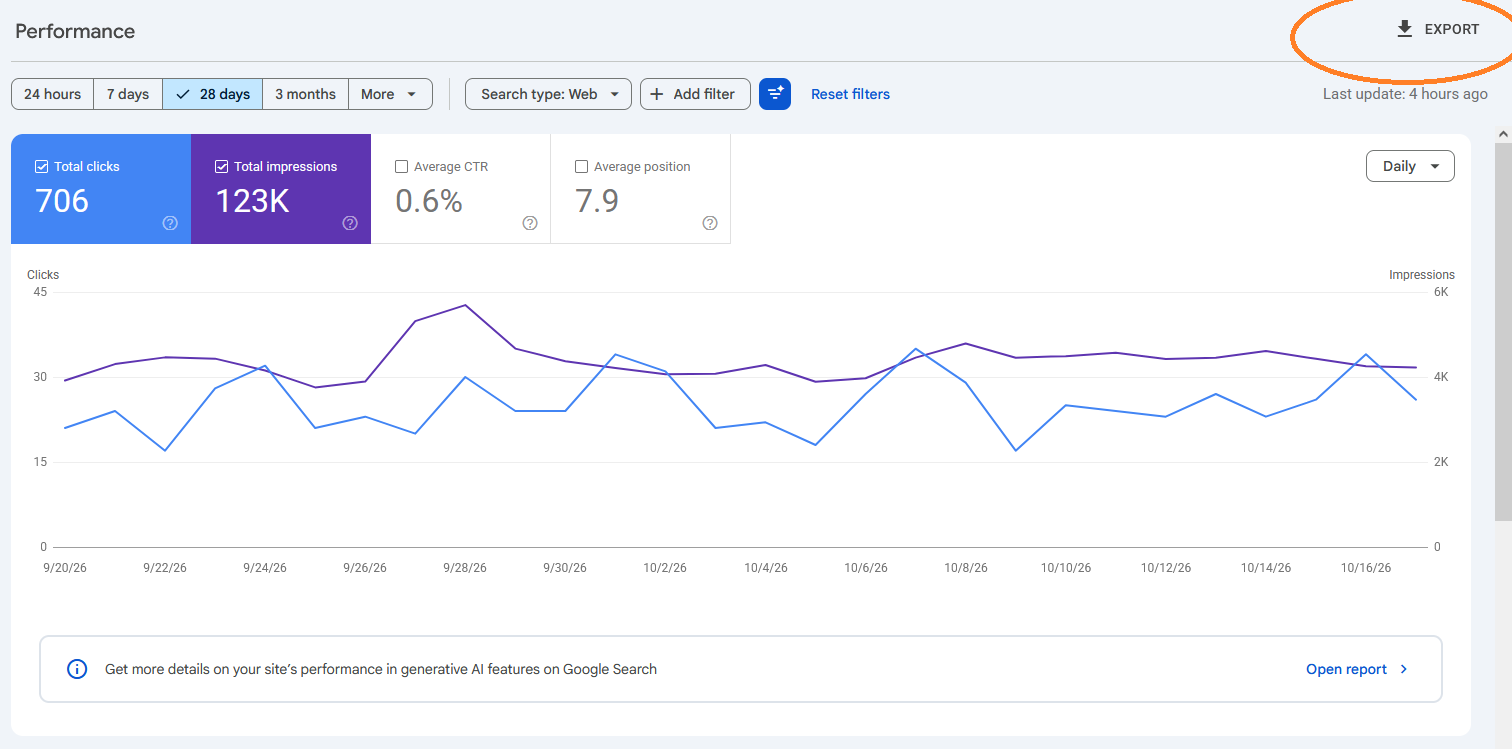
Click on it and select “Download CSV”. CSV is a lightweight format for data that can be expressed in a table or spreadsheet. It’s the better choice for what we’re looking to do here. It will download a zipped file, so unzip or extract the contents. It should look like this. Select Queries.csv and open in Notepad if you want to check it — it’s a list of your top 1000 keywords. GSC has a limit of 1000 keywords that it gives you for free, but if you’re running a small business site, that should be enough.
What you can then do is take this CSV and upload it to a chat with ChatGPT, Claude, Gemini, or whichever AI/LLM you prefer using. In fact, this is a particularly good use of LLMs: slog-work that it can give you a pretty-accurate answer for. That being said, we would do it like this to minimise the risk of mistakes:
- Start the chat by being clear about what you want. Give it this as a prompt (or something like it in your own words, if you at least want a little input on the process!): “I’m looking to figure out the proportion of the keywords my site is ranking for that are seasonal. I’ve got 12 months of data from Google Search Console in CSV format. I want you to look through the CSV and add a column to it, and in each row, add either “Yes” (if it is seasonal) or “No” (if it isn’t seasonal). There aren’t necessarily seasonal keywords in the list. I’ll upload the data now. I want you to go through the first 20 and write in plain text in our chat whether each is seasonal or not, so that I can review how accurate you are. Then I want you to go through them all.”
- Run through the first 20 keywords it gives you back. Ideally there will be a mix of seasonal and non-seasonal, and ideally it will have gotten the answers correct. If not, let the AI know, then have it run through the rest.
- Take a look at its final list of answers. You don’t need to spend hours going through them all, unless it’s vitally important that every single keyword is correctly assigned. It should at least be mostly right.
Et voila! You should have a list of seasonal and non-seasonal keywords. If you transform the CSV into a Excel file/Google sheet, you can then use the data to make graphs about your seasonal keywords.
How to find seasonal keywords with Semrush
Semrush is a third-party SEO tool that’s useful for all sorts of things, among them keyword research. One of the things it can help you with is identifying seasonality for a keyword.
Make your way to their Keyword Overview tool and type in the keyword you want to search for. If the location isn’t set to the UK, set it before clicking Search.
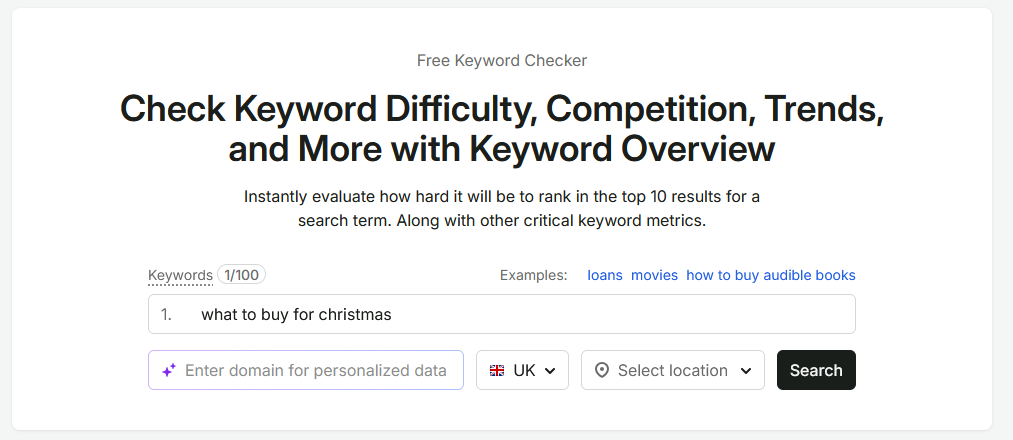
You’ll end up on a page that looks like this:
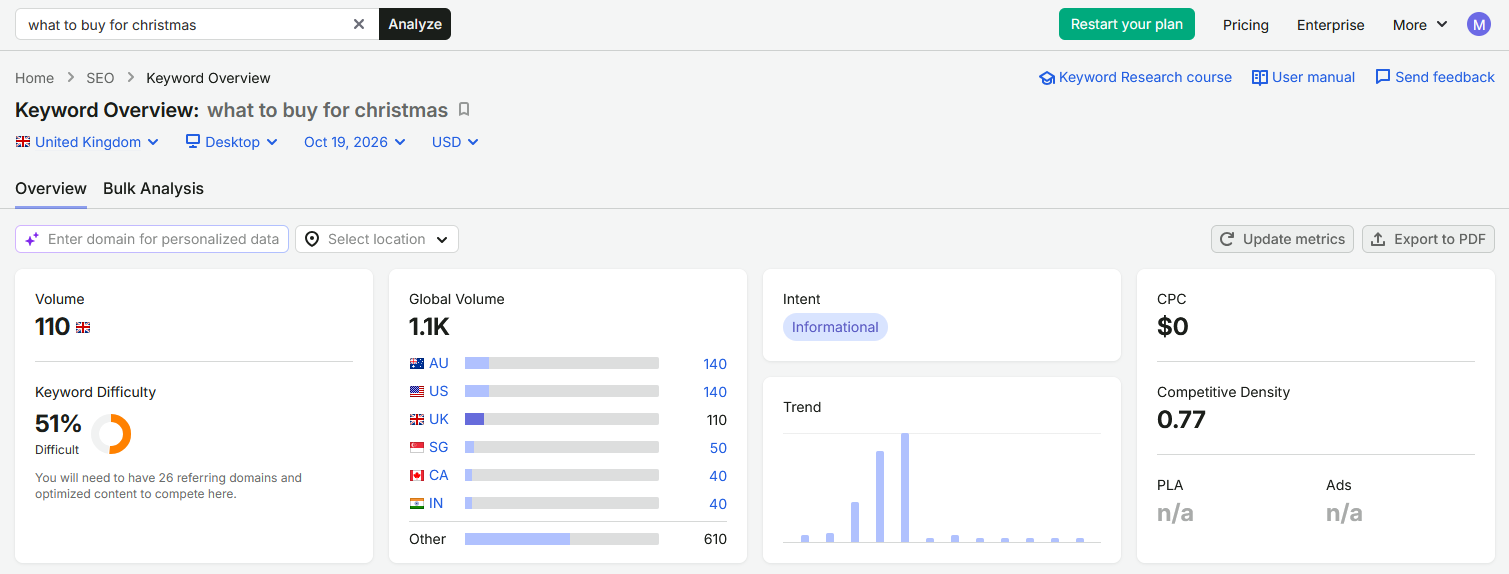
In the centre, at the bottom, is a little “Trend” graph, which is exactly what it sounds like. It seems to start in August (a few months before this post was written) which is a bit odd, but it does make it clear that “what to buy for Christmas” (if you didn’t know) is a seasonal keyword.
Semrush has a paid version (not a sponsor), but you get 10 free searches a day with a free account anyway.
How else to find seasonal keywords
A great way to do almost anything in SEO is to check what your competitors are doing. There’s no exception for when you’re finding seasonal keywords.
Start by searching for a seasonal keyword relevant to your business. Search for it in Google and look at what comes up — these are your competitors (from an SEO perspective). Start with the one in first position — click through and have a snoop around. What keywords are they using alongside the one you searched for? What other seasonal landing pages do they have? What other seasonal blogs do they have? What are the page titles on these seasonal pages? If you do this for the top ten results in your search, you’re pretty much guaranteed to at least find a bunch more keywords related to your search, if not examples of entirely different seasonal keyword clusters you hadn’t even thought of.
Then, of course, there’s AI. If you don’t fancy switching your brain on, talk to your LLM of choice. Tell it what your business is, what service lines you offer, what products you sell, and so on. Then tell it the seasonal keywords you’ve already thought of. It will come back with a bunch of ideas that you can then feed into your keyword discovery process, i.e. Semrush or manual research. LLMs are at their best as spitballing idea machines, so this is a great use for them.
How to use seasonal keywords
Alright, that’s enough fluff. We know what seasonal keywords are, we know how to spot seasonal keywords, but what’s the point if you’re not putting them into action? Here’s a quick rundown on how to use seasonal keywords as a way to boost your rankings.
- Identify the seasonal keywords that could help you. Keyword research is central to any SEO campaign. Use the methods outlined above to pick out your keywords.
- Assign seasonal keywords to landing pages and blogs as part of your content plan. Keywords are useless unless you use them properly and consistently. Create a content plan so that you can identify which pages you will use to target each keyword cluster.
- Add seasonal keywords to your page titles, headings, and contextual content. Go through your pages systematically adding your seasonal (and non-seasonal!) keywords.
- Request re-indexing through Google Search Console. This will speed up the process of Google noticing that your pages have changed.
- Build backlinks to your seasonal pages with seasonal keywords as anchor text. The anchor text is the blue bit, the clickable bit of the link; e.g. the anchor text for this link is “this link”. Building links to your Black Friday page with Black Friday keywords is SEO 101.
- Update your seasonal content with fresh keywords. Some seasonal keywords go out of date (like “What to buy for Christmas in 2025”). If you have an old blog centred around a dated keyword like this, go in and update it.
- Redirect old seasonal pages to new ones. Alternatively, you can create a fresh landing page or blog each year to target that year’s seasonal keywords. If you do, redirect the old landing page/blog to the new one. This will transfer the SEO power of any backlinks pointing at the old page to the new one.
Other than that, build content and improve your site’s site speed as normal.
Looking to rank for seasonal keywords but don’t know where to start? Get in touch today.