A long tail keyword sounds like something you might find in a zoo. Unfortunately that’s not the case — all they are is search terms that don’t get much search volume. So how do you find long tail keywords and how do you target them in an SEO campaign?
You find long tail keywords by using one of several SEO tools like Semrush, Ahrefs, or SERanking. You start by thinking of what your potential customers or clients might search for, then find real high-volume keywords based on your ideas. You then use a keyword generator tool to find keywords on the same topic with less search volume — those are your long tail keywords. To rank for long tail keywords, take the keywords you find and add them to a content plan; they can be secondary keywords on core pages, or primary keywords in long tail blogs. You optimise for them by adding them to the contextual content and headings, as well as the page title / meta description / H1 if you’re treating it as a primary keyword.
If you want to learn how to rank for long tail keywords — starting with finding them and ending with how to use them — read our post below.
What are long tail keywords + examples
A long tail keyword, for the uninitiated, is a keyword that has low search volume — i.e., there aren’t many people searching for it per month. The origin of the name is, I’m sorry to say, to do with maths.
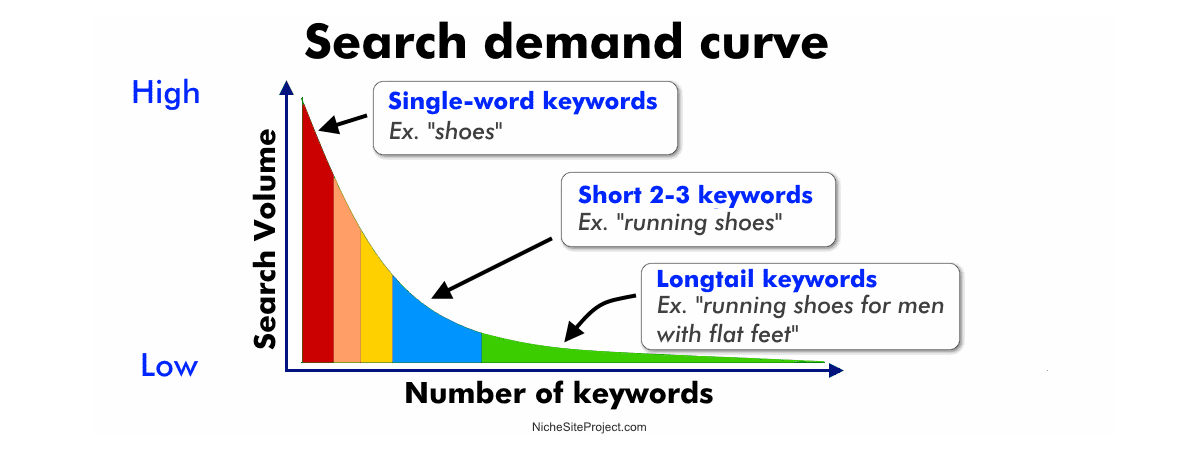 Thanks NicheSiteProject for the illustration. “Long tail” comes from graphs like these, where the majority of traffic comes from the “long tail” of keywords which there are lots and lots of, but which have low search volume. Long tail keywords often have the following qualities:
- They tend to have lower competition. Less search volume means less competition, and less competition means you have an easier time ranking.
- They tend to be longer. As you might imagine, “long tail keywords” has more search volume than “what are long tail keywords”.
- They tend to be informational. There are four categories of keyword: informational, navigational, commercial and transactional. Navigational keywords are for finding your way somewhere; commercial are for comparing products; transactional are for buying things now. Informational keywords are just for people looking to learn something, and often take the form of questions, like “why should you target long tail keywords”.
- They tend to fit best on a page as an FAQ or in a blog. Since they’re longer, and since they have low search volume, they’re less well-suited for use in page titles and H1s and more suited for fitting in lower down in a page, like in an FAQ accordion box. In other words, they’re better as secondary rather than primary keywords.
All-in-all, your first instinct is probably that these keywords aren’t worth targeting: they each don’t get much traffic, you’d have to do a lot more work to target them all than to target one high volume keyword, they’re more awkward to use on a page due to their length — but there are good reasons to include them in your content planning.
Are long tail keywords better?
Long tail keywords aren’t inherently better than short tail / high volume keywords. It just depends on what you want to use them for, what stage of development your business is in, and your SEO budget.
Let’s say you run the in-house marketing department at a big, international law firm. You’ve got a big international law firm budget to play with and you’re looking to outsource some of your SEO, including content creation and link building. Great! If that’s you, I would definitely recommend targeting short tail keywords like “divorce lawyer” or what have you (particularly with your link building). You don’t have to ignore long tail keywords completely, but if you’ve got the firepower to try and rank for high volume, high-conversion keywords, you should.
Alternatively, let’s say you’re a small trader and you’re doing your SEO on your own. If you try and target equivalent short tail keywords in your industry, then to be blunt, you’re probably going to put a ton of time and effort in but not see anything in return. It can take an awful lot of money to hit the #1 spot for high-competition terms. But if you pick your keyword targets carefully — keywords that have a little bit of volume and much less competition — then you can start seeing returns on your time/effort/money before reinvesting them into your marketing campaign.
So it’s very much a case of horses for courses: what’s better for you would be worse for someone else.
Why focus on long tail keywords?
The top reason to focus on long tail keywords is the relative lack of competition. The less search volume, the less likely that someone else with a bigger budget or better content will be trying to rank for it too.
The history of long tail keywords is a bit of an odd one. They very much became popular in the mid 2010s — I was there! — when people realised you could bypass the big backlink budget competitors fighting over high-volume keywords and get just as many converting customers by targeting the long tail. This got a little out of control as the decade went on, with more and more freelancers and day-job-quitters making random niche sites on things they weren’t even experts in just to try and make money from ads and affiliate links — not the worst crime, but also genuinely bad for information quality on the internet.
Google fought back against this, first by creating a distinction between unimportant topics and “YMYL” topics — “your money or your life” — where information quality mattered more, and they prioritised ranking sites made by real, recognised experts. If you remember in the early 2020s when blogs started being “cowritten” or “fact checked” by “real dentists/vets/accountants” (and so on), that’s why (and yes, they were by and large just being given money for their likeness to be used rather than having any active part in content creation or editing). Since then, Google only made the rules stricter and prioritised expertise more — until they decided “oh wait, actually it’s in our interest to spew unmeasurable mountains of unaccountable BS across the entire internet with AI Overviews, so yeah, mountains of BS are fine now.”
The point of all of this is that the main argument in favour of long tail keywords isn’t as true as it once was — because now you’re not just competing against business competitors and solo blogs, but also AI Overviews, the whole point of which is to stop users visiting websites and to stay within the Google ecosystem. Google are a business after all. There are still gains to be had, just not as many.
How many words in long tail / short tail keywords
There’s not a one-size-fits-all definition, but a rule of thumb is that if the keyword is only a couple of words long, or maybe three words long, it’s probably short tail. For a more definitive answer you can at least divide your own keywords into short tail and long tail groups. Short tail would be the ones that have the higher search volume, long tail would be the ones that have less search volume, if not nearly zero.
If we talk about this post as an example, the short tail keywords we’re targeting will be ones like “long tail keywords” and “short tail keywords”. The long tail keywords are more along the lines of “how to find long tail keywords”, “how to target long tail keywords”, and so on.
How to find long tail keywords
So, we know what they are and why you should target them. How do you find long tail keywords?
What tools find long tail keywords?
The best way to find long tail keywords is with one of several free tools. The most popular of these is probably Semrush, which is a multi-purpose digital marketing tool that I personally use every day. Among other tools you can use for free are their Keyword Overview and Keyword Magic tools, both of which can help you find long tail keywords to target.
Another similar tool is Ahrefs, which is like Semrush but slightly better, and with fewer tools available for free. There’s also SERanking, which is like a budget version of Semrush/Ahrefs, and maybe slightly more user friendly for beginners (although that’s subjective). I would recommend Semrush as your first port of call.
How to find long tail keywords with Semrush
First things first, go to semrush.com and make your way to their Keyword Overview tool, the one in the screenshot below. Type in a keyword that’s relevant to your business, make sure the location is set correctly, and click Search. We’re looking at the keyword “estate agent in london”.
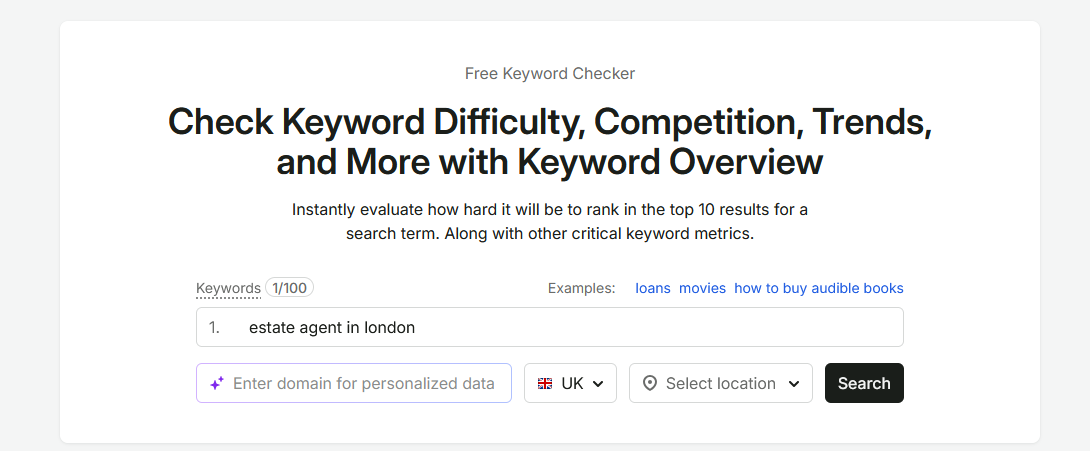
You’ll end up looking at a load of interesting data related to the keyword. At the top of the page, you get core data like keyword search volume (here, 320 searches per month), keyword difficulty i.e. how hard it is to rank for, global search volume, search intent, trend data, and ad-related stuff that isn’t relevant here. But if you scroll down, you’ll see a couple of features you can use, under the heading “Keyword ideas”. These are keyword variations and questions.
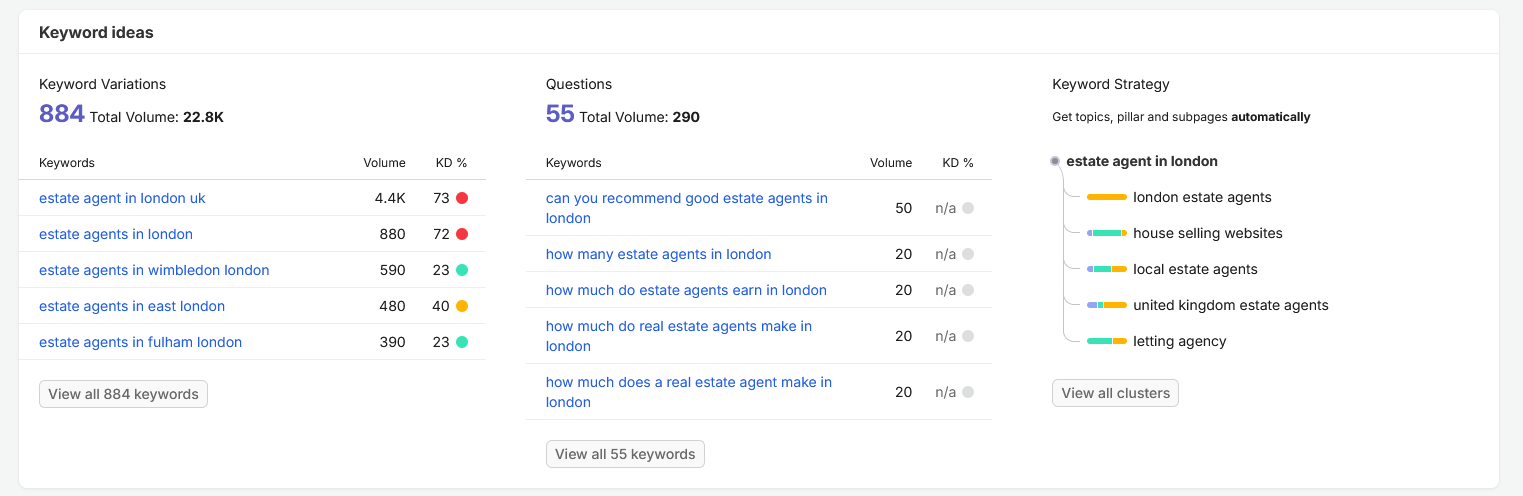
The keyword variations are useful here because they show whereabouts the search term “estate agent in london” falls within the hierarchy of primary/secondary or short/long-tail keywords. Our keyword gets 320 searches per month in the UK, whereas “estate agent in london UK” gets 4400. I’m not sure I quite believe that — Semrush data isn’t infallible — but the point is that at face value, the data is telling us “estate agent in london” is a long-tail keyword here. If you click through where it says “View all 884 keywords”, i.e. view all the keyword variations, it shows you more of them in a big table like this.
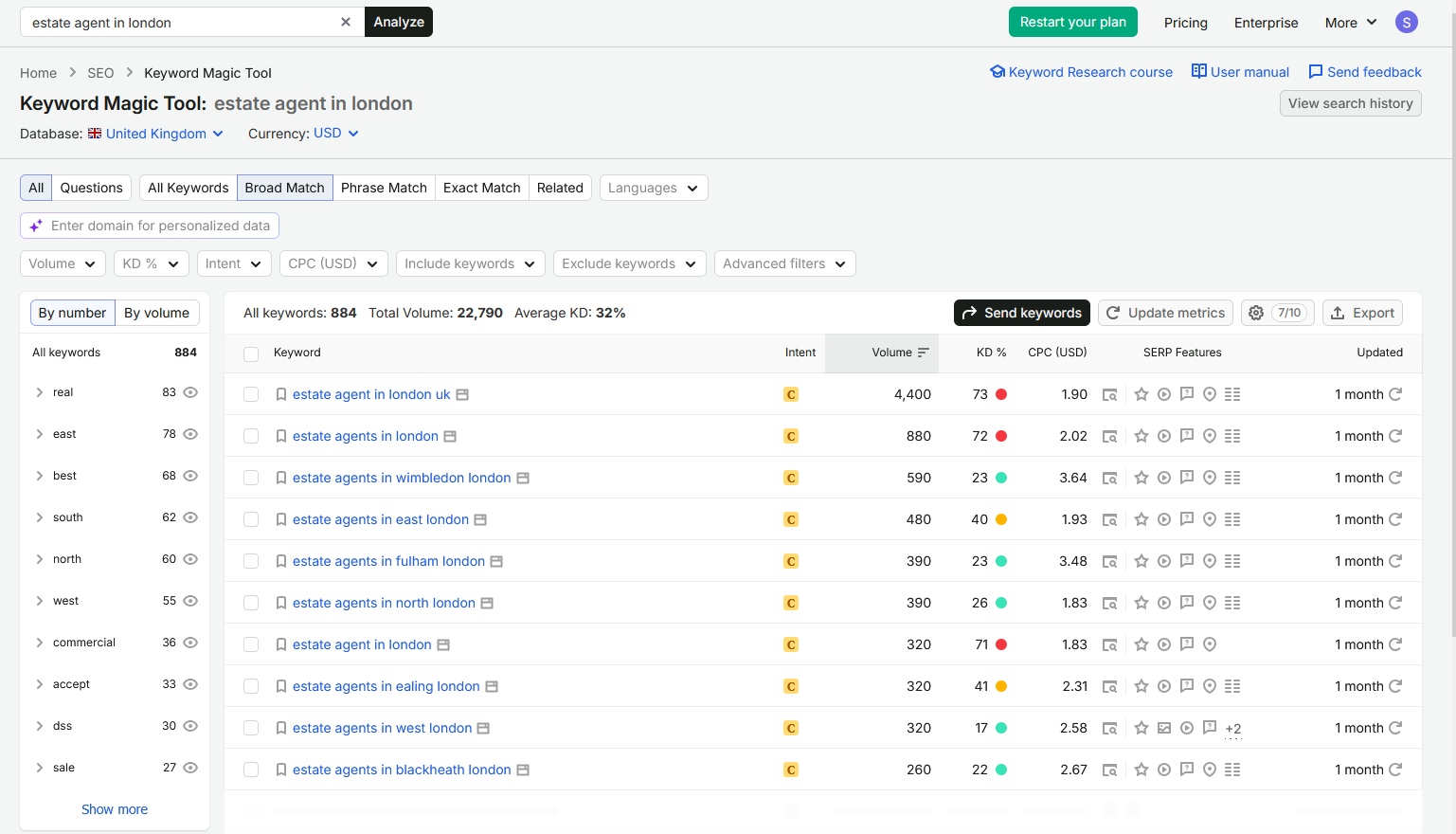
The search volumes, again taken with a pinch of salt, make sense at face value: the less specific “estate agent in london UK” gets more searches than its more specific variants pointing at particular boroughs. So, an estate agent building a location page for London could use “estate agent in london UK” as a short-tail keyword and the rest as long-tail. In practice, that would mean putting the majority of focus on wherever the most searches are.
Also worth looking at here are the questions. These are almost always a level of search volume you could describe as long-tail. In the example above, the top one with 50 search volume is “Can you recommend good estate agents in London”, followed by general informational searches like “How much do estate agents earn in London”. These could make good blog topics; they aren’t always relevant to a landing page (e.g. if you’re selling houses in London, you wouldn’t have a heading or FAQ on your landing page about how much estate agents earn).
How to extract long tail keywords from Ahrefs
Getting long tail keywords from Ahrefs is a similar process. The only downside is that to get access to their full range of keyword tools, you need to be a paying subscriber. What you can do instead is use their free keyword generator. As the name suggests this is a tool that lets you get keyword ideas (including for long tail keywords) for free.

So: type in whatever keyword you like — something you think will have a few related long tail keywords that might come up. Here we’ve gone for “jobs in Manchester”, which might be a good keyword for a recruitment agency. One based in Manchester anyway. Set the location if it isn’t set automatically and click “Find keywords” to get your keyword ideas. If it’s a topic with some volume and variations, you’ll get something like this:
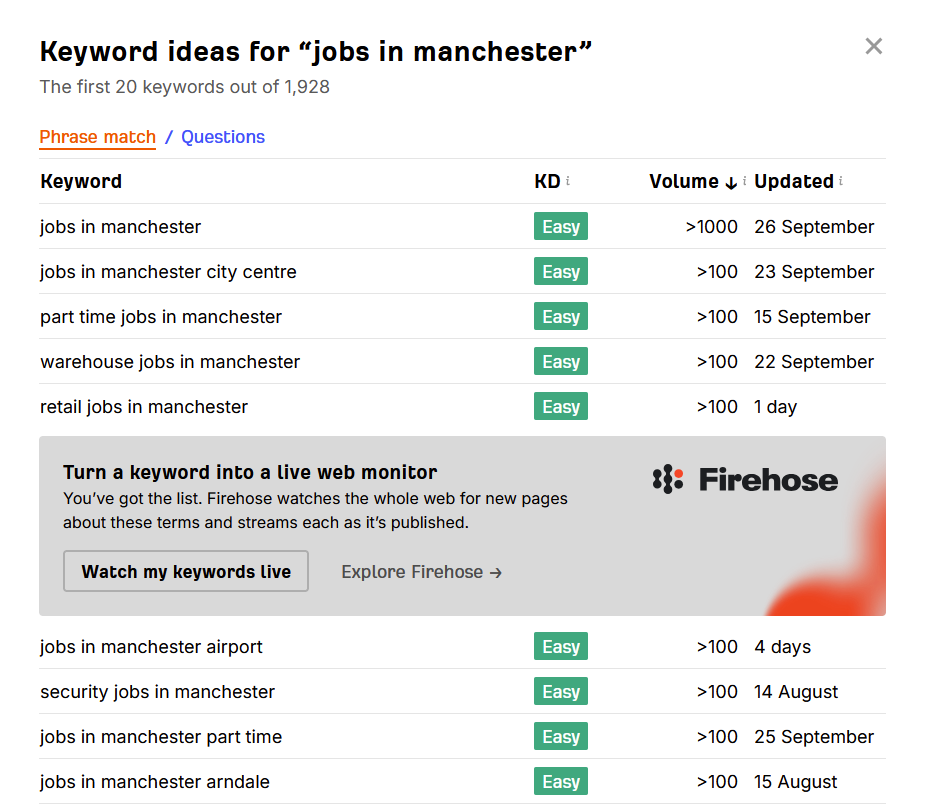
This turned out to be a good example: it found that the keyword we gave gets somewhere shy of 1000 search volume per month, which is good to know. But the important thing here is that it gave us eight useful long tail keywords like “jobs in manchester city centre”, “retail jobs in manchester”, “jobs in manchester arndale” — all more specific and with fewer searches per month than our given query. And unlike the typical informational queries you see a lot of in long tail keywords, these are all suitable to sit on a recruitment agency’s core Manchester landing page. And, of course, they’re free with no usage limit (at least not one that I’ve ever hit using this tool to quickly check keywords).
How to find long tail keywords manually
If you’re not particularly interested in things like search volume and search intent, and you just want ideas, there are ways to do keyword research manually — and this is something I still do, every time I make a content plan.
Head to Google and search for one of the core keywords you want to find related long tail keywords for. Let’s say you run an architectural practice — so start by searching for “architectural practice”. Really as simple as that. Scroll down past the AI overview and sponsored results until you find the People Also Ask (PAA) questions, which if you’re unfamiliar, look like this:

As the name suggests these are typically things that people search for, so can contain high-volume/commercial keywords (e.g. top architectural practices) or long-tail informational keywords (i.e. the PAA can be used as is, like in the title of a blog). And if you scroll down further, you’ll see this — the “People also search for” section.

Now, both of these used to be a bit better than they are today. In my opinion Google watered them down a few years ago, maybe because they weren’t all that commonly used. You’ll often see nonsensical repeats (that “What is the 80/20 rule in X” is one you see all the time across all sorts of topics that don’t make sense). You’ll also see random placenames appended to the end of whatever you searched for; here “architecture practice Manchester” makes sense, but you’ll also often see examples along the lines of “brown shoes Manchester” where the location is irrelevant. Even so, you can still get keywords and blog ideas directly from these Google features.
How to use long tail keywords
You’ve got your long tail keywords, now it’s time to use them. Use them right and you’ll rank for them, use them wrong and you could actually tank your site’s traffic. Big difference! So let’s learn how to target long tail keywords.
Where to include long tail keywords in website
The best place for a long tail keyword depends on what type of keyword it is. There are four types: informational, navigational, commercial and transactional. Informational-type are questions, navigational-type are literally for finding your way somewhere, commercial-type are for comparing products and services, and transactional-type are for buying/booking something now.
- Informational-type long tail keywords might be things like “What does an audit mean in accounting”. If that’s the kind of long tail keyword you’re thinking of, it would be best used in a blog, either as a core topic or as a section heading.
- Navigational-type long tail keywords are branded keywords like “Pollinate Marketing phone number” or “Pollinate Marketing reviews” — keywords where the searcher already knows where they want to go and is using Google not to explore or learn, but just get where they need to be. You don’t typically need to target them, but if you, add them to whatever page is most relevant, like your about page.
- Commercial-type long tail keywords often belong in blogs, but often don’t. Something like “best small business accountants in Manchester” could be used either on a landing page (saying WE ARE the best) or in a listicle-style blog (top 10 best…)
- Transactional-type long tail keywords by contrast are best used exclusively on landing pages. If you searched for “buy a paddling pool online”, where would you want to end up? A category page or a product page? Maybe a home page for a brand that specifically only sells paddling pools? Or a random blog about, for example, HOW to buy a paddling pool or WHY to buy a paddling pool online? Obviously the answer is whatever page matches your search intent, i.e. buying something now.
As for where to include them on your page, it depends. If it’s a page where a long tail keyword would be fine as a primary keyword, you can go the whole hog and add it to the page title, the meta description, page headings and contextual content. If the long tail keyword you’re thinking of isn’t good/important enough to be a primary keyword, you can use better ones as the page title and H1 keyword, and use it lower down the page in a random paragraph.
Where NOT to use long tail keywords
Just as important is where you don’t use them. You should avoid making them primary keywords on key landing pages, for one.
Let’s say you’re trying to get a page ranking on your accountancy website — a service page for PAYE. Well, some long tail keywords around PAYE might be things like “what does PAYE stand for”, or “what is HMRC’s PAYE phone number”. Even outside of information-based searches, most long tail keywords are going to be long, more specific than your service offering, and even more awkward to use than short tail ones. So in this context, I’d recommend making something like “PAYE for employers” your primary keyword instead — or maybe “PAYE for [X industry]” depending on your service offering/the search volume for queries like that.
That doesn’t mean you can’t use long tail keywords anywhere on a core landing page. Rather, you should use them in contextual content (i.e. paragraphs rather than headings and titles), or maybe in FAQ questions and answers. In short, places where they aren’t taking space that could be used by more valuable keywords. This also isn’t a hard and fast rule, and it depends on what you define as a long tail keyword too. But given any keyword, you should always think about whether there’s another keyword with more volume you could potentially target and rank for instead.
Need help with content planning or keyword optimisation? Get in touch today.