SEO is chock full of obscure terms, and if you’re a small business owner working with an agency, you get inundated with them. So, what is keyword search volume and why is it important?
Search volume, meaning the number of searches a keyword gets in a month, is a key SEO metric. There are two different types of search volume: global search volume and local search volume. Global search volume is the volume of searches a keyword gets across the whole world. Local search volume is the number of searches a keyword gets in a specific place. That could be a city, a region, or a country. You can check search volume with a tool like Semrush, Ahrefs, or SERanking. Targeting high-volume keywords is typically more difficult as there’s more competition, so we recommend targeting keywords at a range of different volumes in your content strategy.
If you want to know more about search volume, what level of search volume you should target, and how you can get search volume figures from popular SEO tools — the post below is for you.
What is a good search volume?
There’s no objective answer for what makes a good search volume. It depends on what you’re trying to achieve.
- Zero-volume keywords are search terms that tools say get 0 searches per month. There are a few reasons this might be: incorrect data or rounding errors in the tool you’re using; brand new emerging topics/trends that tools haven’t yet caught up with; hyper-specific queries that get a handful of searches a year. It’s thought that somewhere around 15% of searches on any given day are brand new, never-before-searched-for queries.
- Low-volume keywords (<100 searches a month) or long-tail searches don’t generate much traffic, but have less competition. For this post something like “how to find long-tail keywords for free” is a likely low-volume keyword: specific, wordy, relatively low competition.
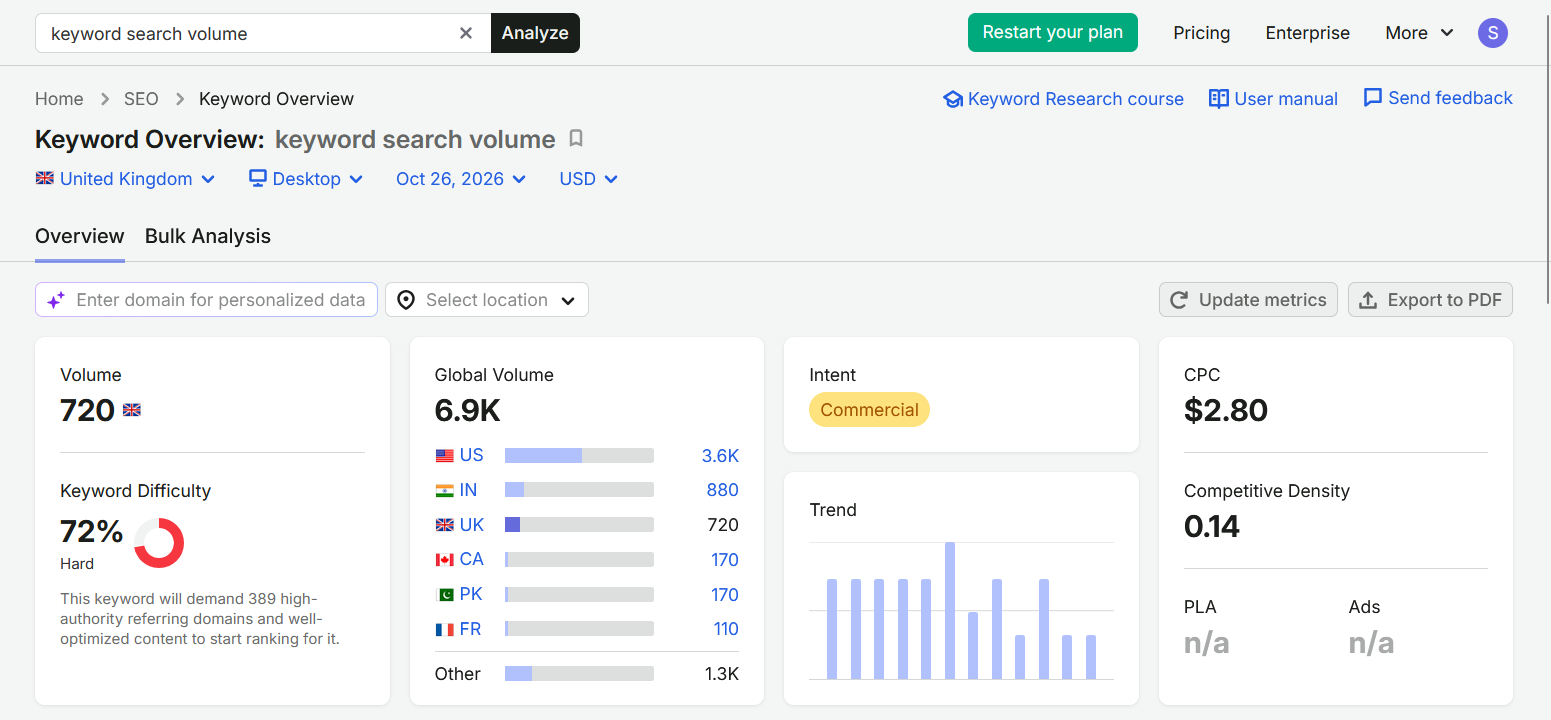
- Medium-volume Keywords (100 to 10,000 searches a month) are a balance between the low and high volume terms. “Keyword search volume” is a medium-volume keyword, with 720 searches a month. Search volume is a relatively niche topic after all!
- High-volume keywords (10,000+ searches a month) are broad, stable, and high-competition. There’s often a lot of money riding on them, or if they’re informational, they’re on a hot topic that gets tons of monthly searches.
When we’re creating a content plan for a client, we’ll include a range of keywords at different search volumes. The keywords with the most volume aren’t necessarily the best, nor the ones with the least competition; the ones that make the most business sense are the ones we’ll go for. We look for a mix of low competition, high volume, and existing rankings — it’s easier to net higher rankings for something you’re already ranking for than it is to break through and start ranking for something new.
How to determine search volume for keywords
Let’s say you’re doing keyword research to make a fresh content plan. Good going! Well, there are a few ways to find keyword search volume data.
How to get keyword search volume with Semrush
Getting keyword search volume figures through Semrush is easy, even if you’re an absolute beginner. It’s one of the main things Semrush is for.
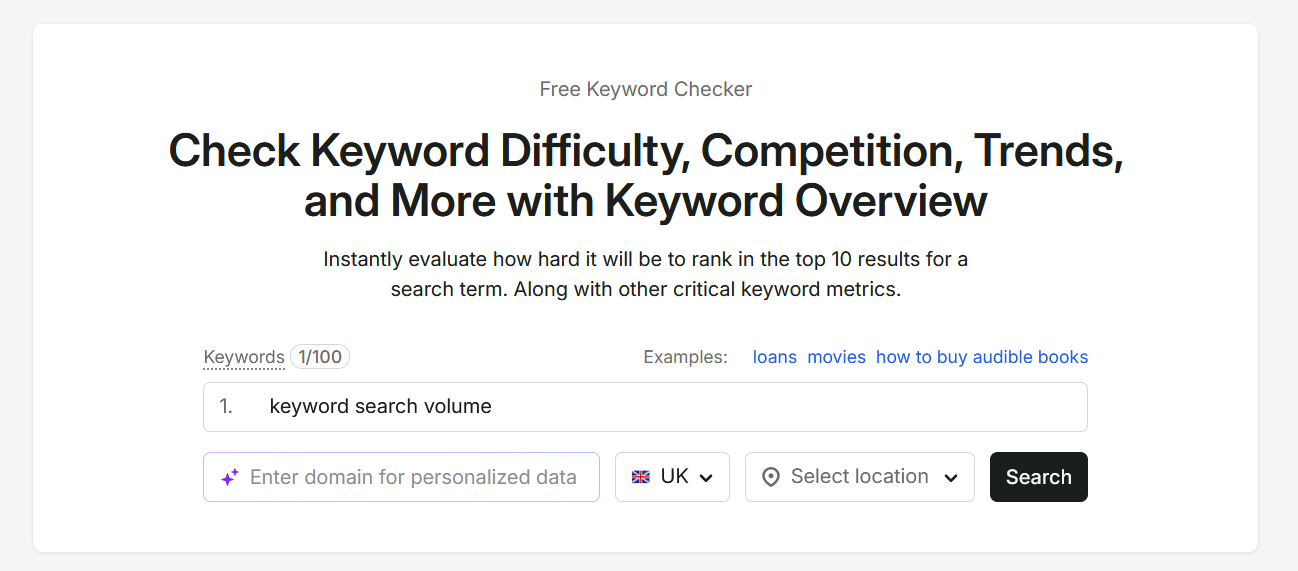
Start off by making your way to the Semrush keyword checker tool. Type in the keyword you want to search for (in this case, we’re searching for “keyword search volume”). If the location isn’t set to whatever you want to set it to, set it, then click Search.
You’ll end up on the Keyword Overview page. This tells you all sorts of things: how hard the keyword is to rank for, whether it’s a seasonal keyword or not, what the search intent is, and even stuff like how much you’d have to pay to get ad clicks for it. But more important for us here, it tells us the monthly search volume in the box on the left — here, 720.
Easy! As a free user, you get ten free searches per day. If you want more you can sign up for the free week-long trial and do as many as you like (or, of course, you can just become a subscriber).
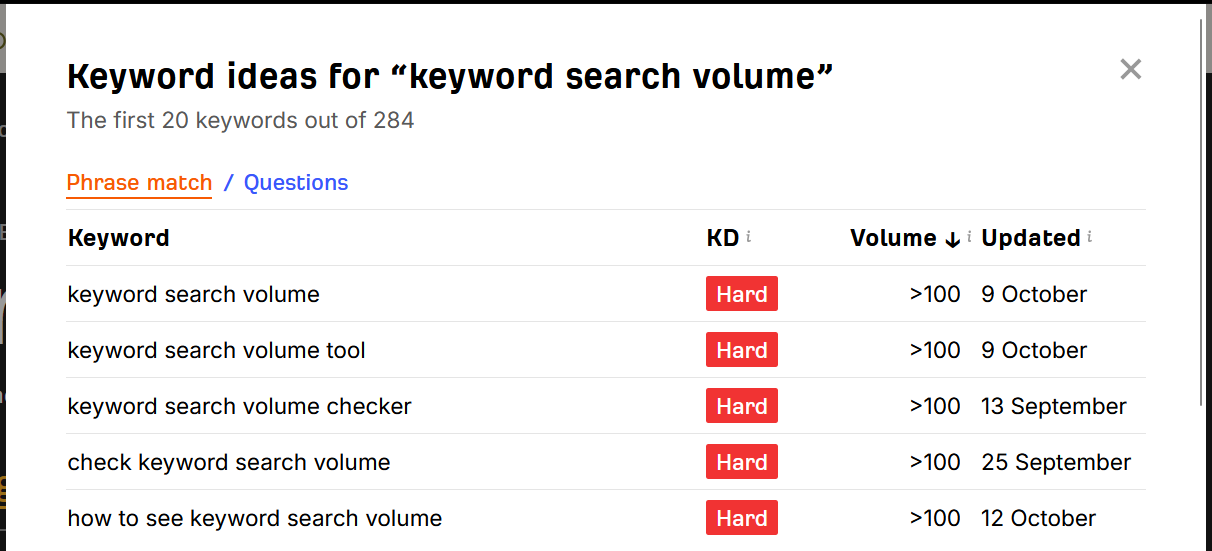
If you don’t like Semrush or you want a second opinion, you can check keyword volume for free with Ahrefs as well. Well, you kind of can. Go to the Ahrefs free keyword generator tool and follow the same steps as for Semrush. You get given a range of keywords, with an estimate of search volume. Not great, but not entirely useless.
There are other tools too, but none you need to bother with in my opinion.
Can you trust the Semrush keyword volume checker?
This is something people don’t appreciate: the keyword volume Semrush gives you is an estimate. It’s not data direct from Google Search. They use something called “clickstream data”, which is like your browser history on steroids: a chronological record of everything you click on and look at online, essentially. They gather data from hundreds of clickstream data providers and use a neural network algorithm to create estimates. The data comes from browser extensions and the like that people install, not knowing what they’re signing up for.
Semrush, Ahrefs and other similar tools used to get their data from a third party clickstream data provider called Jumpshot. Jumpshot was a subsidiary of Avast, the cybersecurity company. In January 2020 it was discovered that the supposedly anonymous data… wasn’t anonymous (shocker) and there’s currently a big lawsuit ongoing as of the time of writing (2026); Avast are in such hot water that they have to have a banner about it on their site (see below).

So, no, you can’t trust Semrush keyword volume estimates and there are a few reasons why!
Where do we get search volume data from?
When I want to get search volume data for a client, I use a mixture of SEO tools. I start with Semrush for a couple of reasons:
- If there’s something I want to directly show a client on the Semrush website, they can access it with a free account / look things up themselves on the same platform that I’m using
- Semrush data isn’t perfect but it’s good enough
I do always clarify though: it’s just an estimate. Just because a keyword has 0 volume on Semrush, that doesn’t mean it isn’t worth targeting (or vice versa if it has lots of volume). If it’s particularly important that we get an accurate search volume figure, I’ll compare the volume across multiple tools, including Ahrefs.
If you’d like to identify keyword search volumes for keywords you want to target — or you just need general help with content planning — give us a call today!