SEO is chock full of terms you’re probably not familiar with. So, what are primary and secondary keywords, and how do we use them in our content strategies?
A primary keyword is the keyword you most want a page to rank for. Primary keywords can be informational, navigational, commercial or transactional depending on what the page is for. Secondary keywords are “nice-to-have” — ranking for them would be good, but they aren’t quite as important as the primary keyword. What the primary and secondary keywords for a page are is up to you. You use them to improve your rankings by adding them to your page title and headings, adding them to contextual content, using them as anchor text for internal links, and building backlinks with them as the anchor text.
Below we cover absolutely positively undeniably everything there is to know about primary keywords in SEO, starting with a deeper look at the definition before getting into how to identify and use them.
What are primary and secondary keywords?
In SEO primary and secondary keywords are basically in the eye of the beholder. So to speak. You can make any keyword you like into a primary keyword; all it means is that’s the keyword you want that page to rank for more than any other, and which keyword that is, is up to you.
For this post, we picked “primary keywords in SEO”. My thinking was that, yes, there are higher volume keywords, but it’s unlikely that we’ll beat the competition to rank for such a broad and high-volume term as “primary keywords”. A few of the secondary keywords we picked are “main keyword”, “main keywords”, and “primary keyword or phrase” — so variants on a theme plus broader rewordings. We’ve also used comparative terms like primary vs. secondary, terms related to only secondary keywords, and broader question-based informational terms. A nice mix.
Another term people get confused by here is long-tail keyword, and there’s often crossover between long-tail and secondary keywords. Long-tail keywords are keywords that are part of the “long tail” of traffic you get on your site; in other words, there are typically a handful of keywords that net most of your traffic, and a whole lot more that get one or two clicks each per month. They’re called long-tail keywords because of where they belong on this kind of graph:
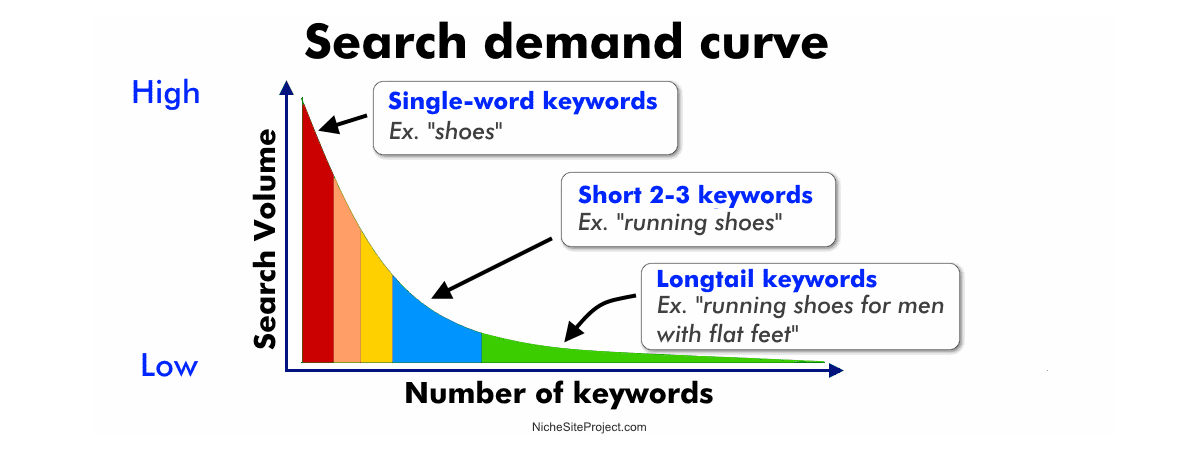
Thanks for the graph go to NicheSiteProject. The idea is that the right-hand side of the graph looks like a long, stretched-out tail. Secondary keywords are often but not necessarily long-tail keywords; a long-tail keyword can be a primary keyword, and a high-volume keyword can be a secondary keyword, if you want. But people tend to target higher-volume keywords as primary keywords and lower-volume ones as secondary keywords, as you might imagine.
How to choose whether a keyword is primary or secondary
It depends on what strategy you want to use.
The typical strategy is to identify the keywords that are the most likely to bring in new business and make those your primary keywords. SEO is worth it for small businesses so long as it’s focused on turning budget into revenue; if your site is attracting more users but they aren’t converting to customers, we would call your traffic a “vanity metric”, because it looks good but there’s no substance underneath. So, when choosing primary keywords for the various pages on your site, we would recommend choosing the more valuable ones. These tend to be commercial or transactional with at least decent search volume and relatively low keyword difficulty. The bigger the budget, the higher the search volume you can target.
At the other end of the spectrum, for years people have targeted very low search volume long-tail keywords as a core part of their blog content strategy. This became popular particularly with people building their own informational sites (although that’s less popular these days due to AI Overviews, LLMs, etc. etc.) The idea was that because nobody else was targeting these long-tail keywords as primary keywords, they had a free run at them — no competition, easy rankings. The search volume was low, but they could hoover it up when no-one else was looking. The logical extreme is in targeting search terms that in tools like Semrush actually display zero clicks per month, on the off-chance that the volume is wrong or that they might get one or two per year.
The upshot of all that is — it’s up to you what your primary and secondary keywords are.
Is there such a thing as a tertiary keyword?
You can have a third tier of keywords if you like. Some people add niche zero-click informational long-tail keywords specifically as tertiary keywords. We don’t; we would either add those as secondary keywords or within FAQ/People Also Ask questions. You’re going to end up with basically the same content either way. From an SEO perspective I also find that explaining “yes, this is a third tier of keywords that don’t get any search volume, but trust me bro we should target them” is a tough sell. But if you’re making your own content plan, you do you!
How to find primary and secondary keywords
You find primary and secondary keywords through the process of keyword research, and that starts with something you might call “ideation” if you want to be fancy, or “thinking about probably keywords for your site” if not. You sit down and think about what you want to rank for: what services do you offer, and what keywords are relevant to them? Something like this is a good start.
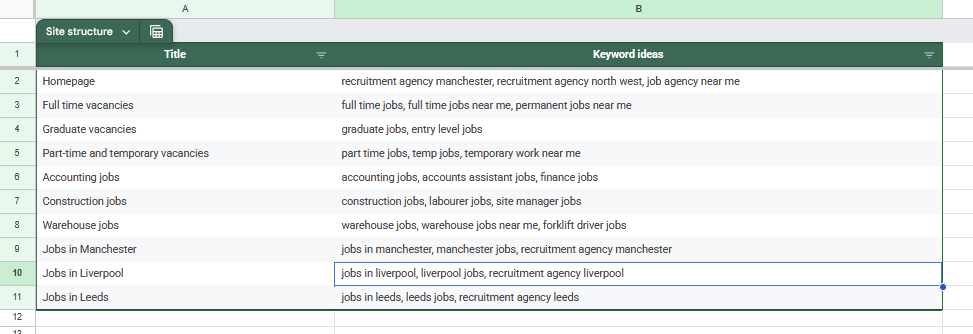
There are a few tools you can use to help you along. Having a chat with an AI like Claude or ChatGPT is a good start. You can also take a look at your competitors and see what they’re ranking for — copy their homework!
How to find primary/secondary keywords with Semrush or Ahrefs
We’ve looked at this in more depth elsewhere, so we won’t labour the point too much. But you can use third-party SEO tools like Semrush and Ahrefs to find keywords for you. The process is basically the same for both. For Semrush, head to their Keyword Magic tool.
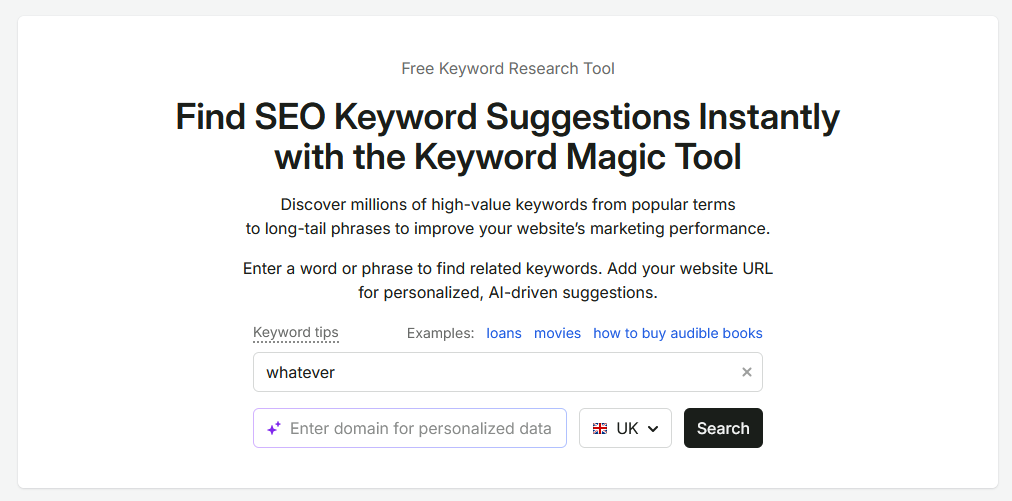
It should take you to a screen that looks like this. You’ll get a list of keywords, ordered by monthly search volume. You also get all sorts of other data about search intent (like is the user just looking for information, or are they looking to buy something), the difficulty of ranking for the keyword, and what SERP features the keyword has (i.e. when you Google it does it show an AI overview, images, etc.)
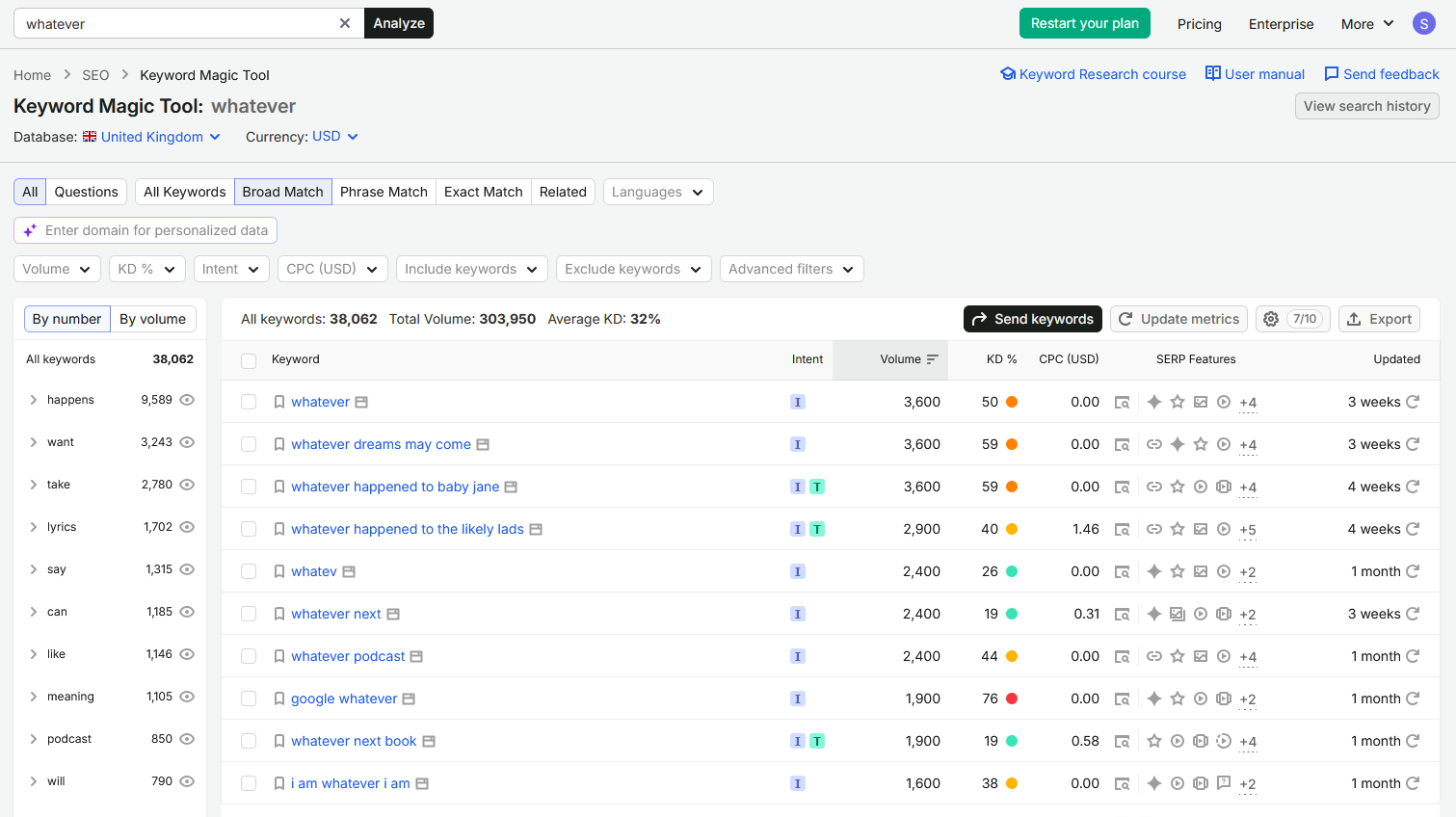
Go through your list of keyword ideas searching for each of them, making a note of the keywords you get and their search volumes. Then when you’ve searched for all of them, pick your favourites, and redo your content plan to look like this:
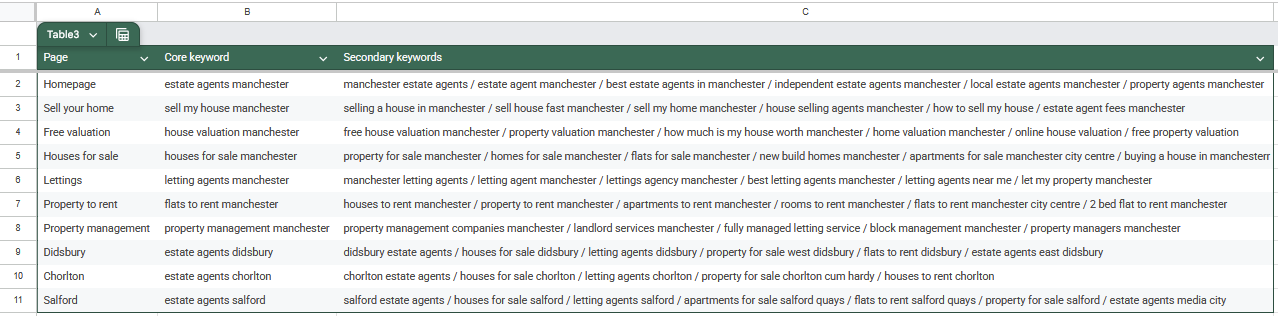
Ahrefs is basically the same process. Their version is Keywords Explorer, but you have to pay to access it whereas with Semrush (not a sponsor) you get ten daily searches for free.
How to find primary/secondary keywords with Google Search Console
If you want to improve your rankings rather than start ranking from scratch, Google Search Console (GSC) would be a good option. GSC (for the uninitiated) is Google’s own analytics tool: you hook it up to your site and it tells you what keywords you’re ranking for on each page, how much traffic and how many impressions they get, how many of your pages are served from Google’s index, and a bunch more stuff most of which isn’t relevant here. Using GSC to find new keywords is probably the most beginner-friendly way to go about it.
Here’s how you can use it to identify new primary and secondary keywords:
- Go to the Performance tab (on the left), wait for it to load, scroll down, and click the PAGES tab
- Pick the page you want to optimise from the list by clicking on it
- When the page reloads, scroll down; it should now show results from the QUERIES tab. These are all the queries that page ranks for
- Look through the queries and pick out new primary and secondary keywords
The keyword that already gets the most traffic is often a good choice for a primary keyword, if it isn’t one already. Alternatively, any keyword that gets a lot of impressions but not many clicks — and/or which has an average position of 10-20 — is a good option too. These keywords are often high search volume, and moving from Page 2 in Google search (i.e., positions 10-20) to Page 1 can net you a lot of extra traffic.
As for secondary keywords, the only limit is the number of them you can fit in your headings and contextual content, so pick a range of them from your query results and use those.
How to use primary and secondary keywords
So, now you know what they are and how to find them, here’s how to use primary and secondary keywords. We’ll start with planning out what you’ll do with them through to writing/rewriting content and building backlinks.
Optimise landing pages with primary and secondary keywords
Let’s start with some bog-standard landing page optimisation. You find the keywords; then you use them on your pages. You use them on your pages by:
- Adding them to your page title and meta description. The page title is one of the strongest content-based signals you can give to Google, so you should always use your primary keyword and maybe a secondary keyword or two in there, length permitting. Something simple like “Instant online property valuation – Thompson’s” would be good.
- Adding them to your on-page headings. Your on-page headings, particularly your H1, are another strong signal. You can be a little looser and more conversational with your H1 than with your page title, but even so, it should be concise. To carry on with the example, you could go with “Book an instant online property valuation today with Thompson’s”.
- Adding them to your contextual content. You should optimise the rest of the text on each page, too. Scan through all the captions and paragraphs underneath headings to find places to put your secondary keywords — for example in service description cards.
- Adding them to an FAQ box. If you can’t figure out a way to naturally fit keywords onto a page, add them either as questions or answers in an FAQ box. This has the added benefit that you can put A LOT of content without clogging up the page, which is a good move if the page is thin.
You should then head to Google Search Console and request indexing for each page you optimise. You do this by pasting the link in the search box at the top and requesting indexing/reindexing.
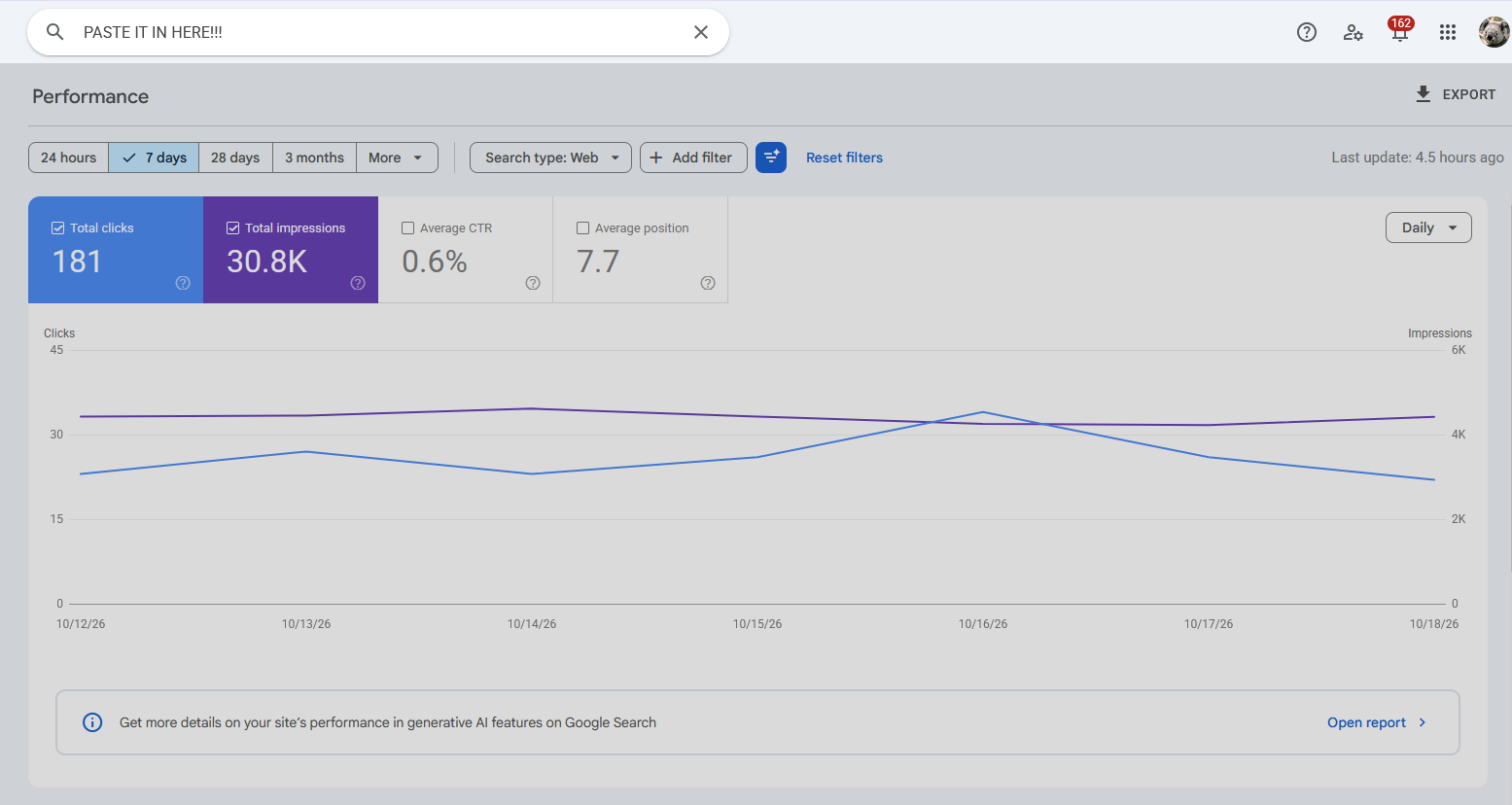
This speeds up the process of Google discovering/crawling/recrawling the page and indexing it in its current form, which if you optimised it well enough, should improve its rankings.
Make a blog content plan
Content is wasted time if it isn’t planned out — so, the first thing you need to do is make a content plan. You should be halfway there with your list of pages, primary keywords and secondary keywords already. The next half of any content plan is blogs.
Small business owners often don’t see the point of creating blogs or ranking for informational blog-type keywords. But there are a few good reasons:
- They improve your topical authority. Topical authority is a subjective measurement of how broadly, deeply, and expertly Google thinks you cover a topic. For any informational term they would prefer that the information comes from a reliable source, so they measure “topical authority” in various ways (including this one) and adjust their rankings accordingly.
- They improve brand awareness. Brand awareness is always good.
- They take space away from competitors in search results. Your competitors are trying to rank for these terms, so you should be too. Even if there’s no value in you having the traffic, there’s value in you taking it away from a competitor.
- They can funnel traffic to high-converting pages. You can view a blog page as the first stage in the customer journey, and use calls-to-action, popups and so on to try and funnel them closer to converting.
- They provide a space for internal links (more on that later).
So, at the bottom of whatever Google Sheet or Excel spreadsheet you’re using to track the primary and secondary keywords on your landing pages, start adding entries for blogs. Ideally, pick out topics that are relevant to the services or products you offer — keep them tight topically to the products and services you offer. If in doubt, look at what blogs your competitors are writing and copy those. Then, start writing or outsourcing. You can use AI but you won’t get as good results.
As for how many times to mention a primary keyword in a blog, that depends on the length of the content. A good rule of thumb is to see what’s already ranking #1 for that primary keyword, check how many times it appears on that page, and copy that. You don’t need to go into more depth than that on keyword density in my opinion.
Build internal links with relevant anchor texts
Now you’ve got blogs, it’s time to use them. From a content strategy perspective, they serve two purposes: first, they bring in traffic from their primary and secondary keywords. But second, they sit within what you might call silos or clusters, which are groupings of pages, each headed by an important page on your site.
Here’s an example. Let’s say you run a property management company, and one of your core services is HMO management. A few sensible blogs you might want to write for your site would be “How does HMO licensing work?”, “What are the fire safety requirements for HMOs”, and “How to manage tenant turnover in an HMO”. Having these blogs rank and earn traffic is good, but you can also give the core HMO management service page a rankings boost by linking to it from the blogs, specifically using the core service page’s primary and secondary keywords as anchor texts. (The anchor text is the underlined text you click on, and Google pays attention to it to figure out what the linked-to page is about/for). So, likely anchor texts here would be things like “HMO management”, “HMO management in Manchester”, “HMO management near me” — things like that. An example a little closer to home would be to link from this blog to our copywriting and content service page.
You can also do this between subcategory pages and their core category page. So, if you sell electronics online, a core category page might be CPUs; your subcategory pages might be Intel CPUs, AMD CPUs, etc. etc. You would link “up” from the subcategory pages to the category page, again using the category page’s primary keyword where possible. This applies to location pages and location-relevant blogs/sublocation pages, too — you can build a silo around any of the core pages you want to rank.
Build backlinks with relevant anchor texts
Last but not least, you can use primary and secondary keywords in your backlink building process, whether you’re buying backlinks, buying press releases, or doing good old fashioned outreach. The exact same applies to backlinks to your site as to internal links: Google pays attention to the anchor text of each link, and the anchor text profile (i.e. all the anchor texts taken together) to figure out what a page is for — so you want to strengthen that signal as much as you can by using primary and secondary keywords (although not exclusively, because an over-optimised backlink profile is bad too).
Strictly speaking you aren’t supposed to buy backlinks. It’s a black hat SEO tactic. But many people do it anyway; it’s a little like an arms race. If your competitors are doing it, you have to match them, right? You can buy backlinks from tons of different places, and the process is almost always the same: you tell them what you want, then they build whatever kind of backlink you need with the anchor text you request. It’s a lot easier than outreach, that’s for sure.
If you need help with anything to do with primary and secondary keywords, from coming up with a content plan to optimising your site or building backlinks, get in touch. We can help!